
Recently I had an unusual experience and made an interesting discovery with one of my students. I would like to share the process with you.
If you recall my post about the 5 practice questions (click here to read it), I have worked hard with one particular student to help him become more engaged in his learning and practice sessions as well as improve the quality of his preparation for his lessons. I say that I have worked hard, because after spending a very long time with this student, I have not been able to measure progress. It is as if there is some sort of disconnect in this student's ability to evaluate his own performance and execution. He does not seem to hear himself when he plays and seems unable to determine how to fix things.
For a long time, I thought it was just a matter of not having the necessary information to practice correctly. And so, I gave him that information. We discussed practice tips and strategies. We practiced these types of skills at his lessons. He would finish each lesson with some forward motion and progress, and then at his next lesson, we would begin anew the same cycle of problems.
I thought too that it might be a matter of not practicing enough, and so I addressed this issue with how my student planned his practice sessions and how much time he spent in those sessions to accomplish the assigned tasks. I did see a small amount of improvement. Many of his classmates came alongside him to offer help, collegial support, and ideas. Again, some progress, but not the progress I was looking for.
So, despite all my usual tricks, nothing really seemed to be making the connection with this particular student. Until last week when something magical happened. Before I tell you what it is, however, I need to pause a moment and tell you another brief story.
My husband has been ill for a long time now. It all stemmed from the accident that I had in May 2014, when I crushed my right shoulder. Although I was determined to heal completely and did so quickly, my sweet husband suffered in a different way, as men often do. They call it PTSD or Post Traumatic Stress Disorder. Although I was the person who had the traumatic event, my husband went into a protective mode in his mind, which then grew to affect other areas of his life.
We have been grappling with all of the problems that come with PTSD, but my husband works with a terrific gentleman who has pioneered several techniques to address the PTSD problems. One of those techniques caught my attention. The subject (my husband) would hold a vibrating disc object in each hand, which the therapist controlled with gentle, alternating vibration to each hand, while my husband would discuss upsetting memories. The purpose of the alternating vibration in each hand was to "wake up" each brain hemisphere and keep the whole brain working during the entire memory process.
Fascinating, yes? I listened to my husband's story about this technique, and I recalled that the brain hemispheres were activated by the opposite hand; e.g., the left brain hemisphere with the right hand, and vice versa. Please understand that this a general discussion, and not a technical one. I do not profess to be an expert in these matters, but as a teacher I have been aware of these ideas and have experimented with different teaching techniques over the years. Now back to my student.
When I encounter a student who has difficulty engaging or connecting with his or her learning, I have often suggested that they speak aloud or pick up a pencil and write something in the music. These suggestions are designed to "wake up" the evaluating left brain hemisphere, because speech, logic, and reasoning are the province of the left brain. So during this student's lesson, I began again to offer my usual suggestions to help him wake up and start evaluating his own playing.
"What do you think you should do here? What do you think the problem is?" I asked. Notice that I used open-ended questions designed to engage him in conversation and thinking. Using "what" or "how" questions work wonders in doing this.
After fumbling an answer and not being able to pinpoint what or where the problem was, I helped him here. Then I tried another technique and suggested that my student write down a particular notation in his music, hoping that the act of writing would wake up his left brain more.
And my student obligingly picked up a pencil and wrote in his music with his left hand! That is when it hit me that he was left-handed and that he was really a right-brained student. Everything about him was about impulse, spontaneity, naivety, feeling, emotion, intuition, fun; he had little concept of time constraints and really lived in the moment. Oh boy, I thought, he is a classic right brain thinker. What I did not think about before that moment was that he was almost completely reliant on his right brain.
After witnessing the pencil use with his left hand, which I knew would continue to activate the right brain, I decided to try something related to the story my husband had told of his therapist's technique. My iPhone has a fun app called AppZilla, which has a bunch of little apps within it. One of the apps is a massager. I turned on the massager vibration and put it in my student's right hand. At first, he actually felt his heart rate increase due to fear. He held it for about 30 seconds. Then I asked him to play the part of his music that he had been struggling with. He sailed through it. I began to think that we were onto something here.
A few days later, he performed for the studio seminar class. His was a simple assignment: play the scale routine as assigned to all of my students, which has been an assignment that my student has struggled with since his first lesson with me. My class watched him struggle once again to be able to play the scale, and I watched until the point when I knew that my student had reached "the bottom" and was unable to continue. I walked over to him and handed him my iPhone set to the massager vibration. The class was unaware of what we were doing or why I was handing him my phone. They could not hear anything, and my student and I did not say anything.
After about 20 seconds, I took the phone and walked away. My student then played the scale just fine. The class was shocked. "What magic was that?" Someone asked. "What did you do?" they wanted to know. My student and I then explained what we were experimenting with.
Followup, my student's next lesson was very different. He sailed through his etude at a very fast tempo, without the constant stumbling and corrections (if any) that I was accustomed to hearing. I asked him about his practice sessions outside of the lesson, and he said that he was using the vibration technique to help him.
Isn't that an amazing story? Especially if we have come across another successful teaching tool?
On a final note, when my husband was working with the therapist on this technique, the therapist stated that he did not think it would take my husband long to get to this whole brain state since he was a musician, and musicians generally use all of their brain. However, this student was not using all of his brain and apparently was not accustomed to using his left brain much at all, judging from his reports of the types of difficulties he has with some school subjects. We are also using my Peterson Body Beat pulsating metronome to gain the same vibration effect as the AppZilla massager.
I am pretty excited about this new idea and look forward to other ways that I might be able to use it. I have met several dyslexic students in the past few years, and I am always looking out for additional ways to help students learn.
Does anyone else have any similar experience like this? I hope that this idea may help someone else in their teaching or practicing journey.
Showing posts with label learning. Show all posts
Showing posts with label learning. Show all posts
Thursday, November 26, 2015


Monday, February 24, 2014
Monday Morning Check In: The Importance of Being Teachable
written by Paula E. Bird, copyright 2014
One of my favorite university classes is my section of String Techniques classes that includes non string players. In this class my task is to teach future band directors how to be future orchestra directors. During the class I teach my students how to play a stringed instrument, although I do not expect that these students will continue to play the violin or viola (they might). The reason I enjoy this class so much is because the students strongly remind me of our need to be teachable.
Both parents and teachers can easily run afoul of this character issue. I have a theory that many teachers were drawn to teaching as a profession because of our innate ability to tell everybody what we know. As a teacher or parent, we are daily put in positions to instruct and guide students or children who do not know as much as we do. We can find it easy therefore to forget how to be students ourselves.
What does it mean to be teachable? Perhaps it is easier to describe someone with an unteachable attitude. When someone is not teachable, you will see such behaviors as:
I do believe that the above attitudes are natural human expressions. We all do these same types of behaviors. These are natural responses. We have all had our glorious moments of unteachableness. So how do we practice being teachable? Here are a few suggestions:
One of my favorite university classes is my section of String Techniques classes that includes non string players. In this class my task is to teach future band directors how to be future orchestra directors. During the class I teach my students how to play a stringed instrument, although I do not expect that these students will continue to play the violin or viola (they might). The reason I enjoy this class so much is because the students strongly remind me of our need to be teachable.
Both parents and teachers can easily run afoul of this character issue. I have a theory that many teachers were drawn to teaching as a profession because of our innate ability to tell everybody what we know. As a teacher or parent, we are daily put in positions to instruct and guide students or children who do not know as much as we do. We can find it easy therefore to forget how to be students ourselves.
What does it mean to be teachable? Perhaps it is easier to describe someone with an unteachable attitude. When someone is not teachable, you will see such behaviors as:
- Whining. This behavior includes expressions that make noise but do not really contribute anything useful to the learning process. What is a teacher supposed to do when the student says things like:
- This is hard.
- This is uncomfortable.
- This is weird.
- It hurts when I do that.
- My hand aches when I hold it that way.
- Stubborn Resistance. This behavior includes reasons why the student does not have to execute the instructions:
- My body just doesn't work that way.
- My hand isn't big enough.
- My arms aren't long enough.
- I can't reach around to play that way.
- I don't really need to play in order to be able to teach.
- I don't intend to be an orchestra director (I make sure this student has my phone number so he can call me later when he gets his first orchestra director job or assignment).
- Passive Resistance. This behavior includes continued incorrect posture despite frequent teacher corrections and instruction. Instead of openly defying instructions with verbal comments, this type of behavior is unexpressed. Still, I believe the underlying mental comments that produce passive resistance include:
- I don't need to do this the way you tell me.
- I can still make it work when I do it differently than you instruct.
- Why can't I just hold it this way?
- Frustration. This behavioral reaction is typical in most learning situations because students expect things to come easy and are disappointed when new skills or abilities do not come after one or two attempts.
- Defeat. This behavior includes expressions as to why the student should be permitted to quit. This attitude shows up after a few attempts. Probably this is the hardest attitude that I have to combat as a teacher.
- I can't do this.
- I'm not cut out to play the violin.
- This isn't the best instrument for me.
I do believe that the above attitudes are natural human expressions. We all do these same types of behaviors. These are natural responses. We have all had our glorious moments of unteachableness. So how do we practice being teachable? Here are a few suggestions:
- Learn a new skill. This can be something as simple as learning how to knit or play the guitar, to learning a new language or starting a new hobby. Take a class. Sign up for something that is entirely new and that places you in the position of student.
- Watch your language. Be aware of any negative language that may creep into your learning environment. Avoid expressions such as I can't or this is hard or I'm uncomfortable. Cultivate positive expressions, empowering affirmations, and uplifting and encouraging statements.
- Guard your attitude. Placing yourself in the position of student is a humbling experience. You are admitting that you do not know everything, and this attitude can be difficult for many of us to accept, if we even recognize that we have this problem. As students we need to cultivate the mindset that we are students and learning from someone else. We need to accept the instruction that our teachers give us with good grace and an open willingness to give it a good shot, and maybe five to 10 times of repetition. If we are Suzuki proponents then we need to give it 10,000 repetitions in order to prove that we are indeed Suzuki proponents. We need to close the door on any attitude that allows us to refuse to do something, to give up, or to excuse ourselves from the task. We need to focus on the attitude that does not allow ourselves to divorce ourselves from the work that is required to develop a new ability.
- Enjoy the process. Rather than suffer frustration because of unreasonable expectations that you will learn things quickly, discipline yourself to enjoy the process of learning. Where does the attitude that we can learn things quickly come from anyway? We know that it is impossible to learn things quickly, whether we are children or adults. Skill development takes time. Allow yourself to experience the learning process. Be fascinated with how you learn, with how you approach new things, and with the joy that comes from adding something new to your human experience.
- Foster fascination. Allow yourself to discover new things about yourself, how you learn, how you follow instructions, what you find tricky, what you perform easily, and what your attitude strengths and weaknesses are. Let the learning process fascinate you as you discover who you really are underneath the teacher or parent facade.
***********************************************
Thursday, February 27 (followup): After writing the article posted last Monday about being teachable, I told my section of string techniques class about the article I had posted that day. I showed them the blog post on the screen, and they read through the article. As the class read, there were moments when one student or another would speak up with delight, "There I am!" or "That's me!" Even though I had not written specifically about any particular student, they were intent on finding themselves represented in the article. The rest of the class was quite enjoyable, as each student seemed to find joy in catching themselves whenever they whined or complained.
Wednesday, January 23, 2013
Teacher Report Card
Written by Paula E. Bird ©2013
I wrote last week about a parent report card [here is the article link], and I promised to provide a teacher report card this week. Parents (and teachers), review the following statements and see if there are any areas that need attention. Parents, be sure to discuss these issues with your teacher.
The teacher's instructions are clear and understandable.
Be sure though that you as the parent are making an effort to understand and to remember the teacher's instructions. I have had instances of parents who do not follow my instructions well because they do not take adequate notes during the lesson and do not make an effort to understand what the child and I are working on. Sometimes parents are distracted by email or text messages on their phone. I had one parent who liked to go through her wallet and reconcile receipts. These parents are sending the message to their children that what the children are doing at their lessons is not as important as emails, text messages, or reconciling checkbooks. Really? Even if a child is at an independent stage in the lessons, would it not be better to look (and be) attentive to what the child is doing?
At some point in book 1, I may lose a few parents who claim that they are "confused" and that things are "so hard to understand" because the form of the songs may be a little bit more complicated than Twinkle. I understand when a parent truly is struggling to understand, but in many of these cases the parents did not seem to want to put in the effort to learn for themselves. Sometimes even parents then begin to insist that the child be independent at this point, even though the child is at early elementary school age.
Nope, the young child is not yet ready to be independent and instead would benefit from the parent's making the effort to stay involved. Here is how I look at it. I have three and four year old students in my studio. If I can teach them the names of the eight notes of the A scale, then surely a parent can learn them too. If we expect young students to remember how to play the form of a song, then surely the parents can learn to remember the form. Anything that a parent expects a child to be able to do should be something that the parent can also do.
I recall an instance of talking with an adult who claimed that they just did not understand how Facebook or computers worked, and that the iPhone (or other smart phone) was too complicated for that adult to understand. I relate the story of the two year old sibling in my studio who picked up his mother's iPhone, swiped the screen on, and then called me. I note that most adults begin to work through their technology issues after they hear me tell how easy it is for extremely young children to figure out. It just takes effort on the part of the adult.
Oh yes, I have heard the arguments that personal communication is better than electronic and that some parents would prefer that their children not be exposed to the big, bad Internet, but parents, please know that your children are quite exposed to the Internet and electronics. It would be better if you, the parent, would be on top of this issue so that you could adequately monitor what your child learns from this exposure. You may keep your house devoid of electronics, but the rest of the world does not. Your church, your school, your neighbors, and your child's friends are probably connected and showing your child how to be as well. Stay on top of this so that you can adequately protect your child from what you call from the bad effects of the Internet.
The teacher explains the points that I should focus on during my home practice sessions with my child.
Be sure you leave the lesson with a clear understanding of what your child's teacher expects you to practice. I can give the parent a detailed list of things to practice, but I am not in the home the other six days of the week. I am not there to gauge the child's energy level, motivation, or other life difficulties. I rely on the child's parents to make those assessments during the week and to structure the child's practices accordingly to best meet the criteria of the moment. If a parent takes careful notes during the child's lesson, then the parent will have at least one lesson plan to follow -- the lesson plan that the parent observed during the lesson. I usually also suggest one or two other games or ways to practice things. If the parent makes a list of these types of practice techniques as lessons progress, maybe in the back section of the parent notebook or on a list of index cards or review cards as Sue Hunt suggests (here are the links to the interview and Sue's website), then the parent will have created a large basket that is full of practice tips and ideas.
The teacher shows me how to be a good home teacher to my child.
The teacher understands the child from the standpoint of a teacher. The teacher is not the parent. The teacher should be role modeling how to teach your child. If the parent follows this same approach and is careful to not to insert the "parenting" aspects at the same time, then the parent will be a more effective home teacher to the child. Parents who insist on regulating behavior during lessons and practices rather than building up a relationship that focuses on the learning environment, may have a hard time being effective home teachers. The teaching and learning environment should be happening at the child's lesson, and it is the parent's responsibility to continue the environment in the home.
A parent who frequently harps at the child about posture issues or who uses an unpleasant tone of voice (signaling frustration and exasperation) is not building a motivating learning environment. Better to turn this energy and focus into some sort of game that aids the student to become more aware of the student's behavior. For example, if the student cannot remember to hold the bow at the proper tilt, then set up a chip game. Place 10 chips on the table, and every time the student forgets to hold the bow at the proper tilt, remove a chip from the student's pile. I guarantee that the student will start remembering to perform the bow tilt correctly after losing two chips without my having to harp on it. The same thing goes for a student making squeaky noises because of speeding, or missing the finger tapes, or any number of other items. Playing a game and finding ways to make the practice sessions more fun will make the entire experience more enjoyable for both parent and student.
The teacher treats my child and me with respect.
The atmosphere at the lessons should be positive and nurturing. However, that does not mean that the teacher should allow misconduct on the part of the child or the parent. I believe that I show my parents and students respect by making sure that they live up to the best that they can be. I very seldom permit a parent or student to talk disrespectfully to each other or to behave improperly to each other or to me. If a parent is talking unpleasantly about the child or making snide remarks about something that the child and I are working on, I will call the parent on it. I will try and do it in a way that is pleasant, but there have been one or two times when I had to call a halt to unpleasant words coming from a parent. We all need reminders now and then, and I believe that I am showing my students and parents the ultimate respect by expecting them to adhere to a code of doing and being the best that they can be. The teacher's giving respect to the parent and student does not mean that the parent and student can misbehave or get away with improper actions.
The teacher understands my child and the best teaching method for my child.
The teacher makes an effort to understand the child's personality and learning styles and to choose a teaching method that best addresses the child's unique styles. The teacher explains to the parent how the teaching method will help the child to learn better. The teacher may also take time to help the parent understand what the parent's personality and learning styles are so that the parent can be a more effective home practice partner.
I would like to remind parents that the teacher is the expert in the music lesson arena because the teacher has spent many years learning how to play the instrument and how to teach music. The teacher should therefore be accorded the appropriate amount of respect for this expertise. Many times I have counseled young teachers who have parents who treat them with disrespect because the teachers are young. I frequently remind these young teachers that they are the experts in their instrument and in teaching, and they should not feel intimidated by the parent because the teacher is young or is not yet a parent.
My child enjoys the lessons and group classes with his teacher.
This statement seems obvious. The child should enjoy coming to lessons and group classes in order for learning to occur. However, when a child is reluctant to attend lessons and group classes, the parent may want to reflect on whether the parent has adequately prepared the child for lessons and group classes. A parent who has not practiced consistently and regularly before lessons and group classes will be raising a child who shows uncertainty and reluctance at lessons and group classes, and who exhibits dawdling and other acting-out behaviors.
My child and I learn something at every lesson.
Generally, the student and the parent should walk away from the lesson with a new lesson learned or a new insight gained. However, if the child and the parent are not learning something at every lesson, the parent may want to reflect on whether the parent is helping to make this possible by providing the fertile ground during the week that makes it possible to teach the child and parent something at every lesson, or whether the parent is dragging down the learning process by not following through at home with consistent and regular practicing. My practice handbooks are very helpful for me to show parents when I have to teach the same lesson over and over because the parent and student are not practicing my homework assignments in between lessons. The parent can do quite a bit here to make this statement ring true -- or not.
The teacher is available outside of the lesson to discuss any questions that I have.
I maintain a very full teaching schedule, and so I have limited time available outside of lessons. I prefer emails or other written communications rather than phone calls because I can spend a little more time reflecting on the communication, and I can answer the communications at my leisure at all hours of the day or night. I love answering parent questions, when the parents present these questions in the written format. I also answer questions during lessons as well, although it is much better to address these things outside of the lesson. Answering questions at lessons often takes longer than the parent realizes, and rather than be hurried in my answers because I am trying to keep to my teaching schedule out of courtesy to my other students, I would rather answer the questions in a more relaxed and thorough manner after lessons.
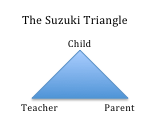 The Suzuki Triangle
So there you have it -- the Teacher Report Card. Notice though how much of the teacher's successful reporting will have a direct correlation to the effort that the child's parent puts into home practices, regular routine, consistent interaction during lessons, and enhancing the home learning environment. That is why the Suzuki world talks about the Suzuki Triangle: the triangle partnership between the teacher, the student, and the child. Every person at one of the points in the triangle is important. Each person at the point of the triangle has a job.
The teacher's job is to teach the parent how to be more effective as a parent, how to be a good home practice partner, and how to teach the child to play the instrument well. These are merely three items, but I could write a book about each item.
The parent's job is to play the recordings daily, practice the teacher's homework assignments daily with the child, set up a nurturing and motivating learning environment (listening, music concerts), and help the child to learn the notes and bowing of the songs the child is learning.
The child's job is to be a child. If the parent and teacher do their jobs correctly, the child will be able to be a child. The child will be able to learn at the child's appropriate pace. The child will learn things from his environment. The parent and child will have happy practice sessions in the home, and everyone will benefit together with happy and productive lessons and group classes at the studio.
I will not be writing a report card for the child, because I believe that the success of the child will be due to the efforts of the adults in the child's life. So, teachers and parents, let's all pledge to be the best teacher and parent that we can be so that our students and children can be nurtured by love to become fine citizens with good and noble hearts.
I wrote last week about a parent report card [here is the article link], and I promised to provide a teacher report card this week. Parents (and teachers), review the following statements and see if there are any areas that need attention. Parents, be sure to discuss these issues with your teacher.
The teacher's instructions are clear and understandable.
Be sure though that you as the parent are making an effort to understand and to remember the teacher's instructions. I have had instances of parents who do not follow my instructions well because they do not take adequate notes during the lesson and do not make an effort to understand what the child and I are working on. Sometimes parents are distracted by email or text messages on their phone. I had one parent who liked to go through her wallet and reconcile receipts. These parents are sending the message to their children that what the children are doing at their lessons is not as important as emails, text messages, or reconciling checkbooks. Really? Even if a child is at an independent stage in the lessons, would it not be better to look (and be) attentive to what the child is doing?
At some point in book 1, I may lose a few parents who claim that they are "confused" and that things are "so hard to understand" because the form of the songs may be a little bit more complicated than Twinkle. I understand when a parent truly is struggling to understand, but in many of these cases the parents did not seem to want to put in the effort to learn for themselves. Sometimes even parents then begin to insist that the child be independent at this point, even though the child is at early elementary school age.
Nope, the young child is not yet ready to be independent and instead would benefit from the parent's making the effort to stay involved. Here is how I look at it. I have three and four year old students in my studio. If I can teach them the names of the eight notes of the A scale, then surely a parent can learn them too. If we expect young students to remember how to play the form of a song, then surely the parents can learn to remember the form. Anything that a parent expects a child to be able to do should be something that the parent can also do.
I recall an instance of talking with an adult who claimed that they just did not understand how Facebook or computers worked, and that the iPhone (or other smart phone) was too complicated for that adult to understand. I relate the story of the two year old sibling in my studio who picked up his mother's iPhone, swiped the screen on, and then called me. I note that most adults begin to work through their technology issues after they hear me tell how easy it is for extremely young children to figure out. It just takes effort on the part of the adult.
Oh yes, I have heard the arguments that personal communication is better than electronic and that some parents would prefer that their children not be exposed to the big, bad Internet, but parents, please know that your children are quite exposed to the Internet and electronics. It would be better if you, the parent, would be on top of this issue so that you could adequately monitor what your child learns from this exposure. You may keep your house devoid of electronics, but the rest of the world does not. Your church, your school, your neighbors, and your child's friends are probably connected and showing your child how to be as well. Stay on top of this so that you can adequately protect your child from what you call from the bad effects of the Internet.
The teacher explains the points that I should focus on during my home practice sessions with my child.
Be sure you leave the lesson with a clear understanding of what your child's teacher expects you to practice. I can give the parent a detailed list of things to practice, but I am not in the home the other six days of the week. I am not there to gauge the child's energy level, motivation, or other life difficulties. I rely on the child's parents to make those assessments during the week and to structure the child's practices accordingly to best meet the criteria of the moment. If a parent takes careful notes during the child's lesson, then the parent will have at least one lesson plan to follow -- the lesson plan that the parent observed during the lesson. I usually also suggest one or two other games or ways to practice things. If the parent makes a list of these types of practice techniques as lessons progress, maybe in the back section of the parent notebook or on a list of index cards or review cards as Sue Hunt suggests (here are the links to the interview and Sue's website), then the parent will have created a large basket that is full of practice tips and ideas.
The teacher shows me how to be a good home teacher to my child.
The teacher understands the child from the standpoint of a teacher. The teacher is not the parent. The teacher should be role modeling how to teach your child. If the parent follows this same approach and is careful to not to insert the "parenting" aspects at the same time, then the parent will be a more effective home teacher to the child. Parents who insist on regulating behavior during lessons and practices rather than building up a relationship that focuses on the learning environment, may have a hard time being effective home teachers. The teaching and learning environment should be happening at the child's lesson, and it is the parent's responsibility to continue the environment in the home.
A parent who frequently harps at the child about posture issues or who uses an unpleasant tone of voice (signaling frustration and exasperation) is not building a motivating learning environment. Better to turn this energy and focus into some sort of game that aids the student to become more aware of the student's behavior. For example, if the student cannot remember to hold the bow at the proper tilt, then set up a chip game. Place 10 chips on the table, and every time the student forgets to hold the bow at the proper tilt, remove a chip from the student's pile. I guarantee that the student will start remembering to perform the bow tilt correctly after losing two chips without my having to harp on it. The same thing goes for a student making squeaky noises because of speeding, or missing the finger tapes, or any number of other items. Playing a game and finding ways to make the practice sessions more fun will make the entire experience more enjoyable for both parent and student.
The teacher treats my child and me with respect.
The atmosphere at the lessons should be positive and nurturing. However, that does not mean that the teacher should allow misconduct on the part of the child or the parent. I believe that I show my parents and students respect by making sure that they live up to the best that they can be. I very seldom permit a parent or student to talk disrespectfully to each other or to behave improperly to each other or to me. If a parent is talking unpleasantly about the child or making snide remarks about something that the child and I are working on, I will call the parent on it. I will try and do it in a way that is pleasant, but there have been one or two times when I had to call a halt to unpleasant words coming from a parent. We all need reminders now and then, and I believe that I am showing my students and parents the ultimate respect by expecting them to adhere to a code of doing and being the best that they can be. The teacher's giving respect to the parent and student does not mean that the parent and student can misbehave or get away with improper actions.
The teacher understands my child and the best teaching method for my child.
The teacher makes an effort to understand the child's personality and learning styles and to choose a teaching method that best addresses the child's unique styles. The teacher explains to the parent how the teaching method will help the child to learn better. The teacher may also take time to help the parent understand what the parent's personality and learning styles are so that the parent can be a more effective home practice partner.
I would like to remind parents that the teacher is the expert in the music lesson arena because the teacher has spent many years learning how to play the instrument and how to teach music. The teacher should therefore be accorded the appropriate amount of respect for this expertise. Many times I have counseled young teachers who have parents who treat them with disrespect because the teachers are young. I frequently remind these young teachers that they are the experts in their instrument and in teaching, and they should not feel intimidated by the parent because the teacher is young or is not yet a parent.
My child enjoys the lessons and group classes with his teacher.
This statement seems obvious. The child should enjoy coming to lessons and group classes in order for learning to occur. However, when a child is reluctant to attend lessons and group classes, the parent may want to reflect on whether the parent has adequately prepared the child for lessons and group classes. A parent who has not practiced consistently and regularly before lessons and group classes will be raising a child who shows uncertainty and reluctance at lessons and group classes, and who exhibits dawdling and other acting-out behaviors.
My child and I learn something at every lesson.
Generally, the student and the parent should walk away from the lesson with a new lesson learned or a new insight gained. However, if the child and the parent are not learning something at every lesson, the parent may want to reflect on whether the parent is helping to make this possible by providing the fertile ground during the week that makes it possible to teach the child and parent something at every lesson, or whether the parent is dragging down the learning process by not following through at home with consistent and regular practicing. My practice handbooks are very helpful for me to show parents when I have to teach the same lesson over and over because the parent and student are not practicing my homework assignments in between lessons. The parent can do quite a bit here to make this statement ring true -- or not.
The teacher is available outside of the lesson to discuss any questions that I have.
I maintain a very full teaching schedule, and so I have limited time available outside of lessons. I prefer emails or other written communications rather than phone calls because I can spend a little more time reflecting on the communication, and I can answer the communications at my leisure at all hours of the day or night. I love answering parent questions, when the parents present these questions in the written format. I also answer questions during lessons as well, although it is much better to address these things outside of the lesson. Answering questions at lessons often takes longer than the parent realizes, and rather than be hurried in my answers because I am trying to keep to my teaching schedule out of courtesy to my other students, I would rather answer the questions in a more relaxed and thorough manner after lessons.
 The Suzuki Triangle
So there you have it -- the Teacher Report Card. Notice though how much of the teacher's successful reporting will have a direct correlation to the effort that the child's parent puts into home practices, regular routine, consistent interaction during lessons, and enhancing the home learning environment. That is why the Suzuki world talks about the Suzuki Triangle: the triangle partnership between the teacher, the student, and the child. Every person at one of the points in the triangle is important. Each person at the point of the triangle has a job.
The teacher's job is to teach the parent how to be more effective as a parent, how to be a good home practice partner, and how to teach the child to play the instrument well. These are merely three items, but I could write a book about each item.
The parent's job is to play the recordings daily, practice the teacher's homework assignments daily with the child, set up a nurturing and motivating learning environment (listening, music concerts), and help the child to learn the notes and bowing of the songs the child is learning.
The child's job is to be a child. If the parent and teacher do their jobs correctly, the child will be able to be a child. The child will be able to learn at the child's appropriate pace. The child will learn things from his environment. The parent and child will have happy practice sessions in the home, and everyone will benefit together with happy and productive lessons and group classes at the studio.
I will not be writing a report card for the child, because I believe that the success of the child will be due to the efforts of the adults in the child's life. So, teachers and parents, let's all pledge to be the best teacher and parent that we can be so that our students and children can be nurtured by love to become fine citizens with good and noble hearts.
Saturday, February 25, 2012
Quick Teaching Tip: Vivaldi’s Phone Number
I helped a student today on Vivaldi’s Concerto in A minor, op. 3, no. 6, in the revised edition of Suzuki Violin Volume 4. We discussed some practice ideas for the section in measures 25-28, which I refer to as “Vivaldi’s phone number.” I believe I first heard this particular nickname for these measures from Terry Durbin at an institute, perhaps Elizabethtown over a decade ago.
The nickname refers to the first note of each group of 16th notes. If you recite the fingering for these notes, it sounds like a phone number. Since Vivaldi lives in Venice, Italy, the phone number is quite lengthy to accommodate the international aspect of the call:
4 – 4 – 3 – 1 – 4 – 4 – 2 – 1 – 3 – 4 – 1 (or 4) – 0 – 2 – 3
 |
| Vivaldi Concerto in A Minor, measures 25-28 |
Students stumble through this passage in their initial playing attempts. There is a reason, and I find this passage is a golden teaching opportunity about how to approach passages in a way that will spur students to achieve success quicker. I also use a similar technique in a passage in Seitz Concerto No. 2, 3rd movement, the first song in book 4:
 |
| Seitz Concerto No. 2, movement 3 passage |
One of the reasons I think students have trouble with both passages is that they are reading every single note, one at a time. For example, in the Seitz concerto passage, the students have great difficulty playing this passage of double notes. When I guide the student to notice that everything is presented as pairs of notes, so therefore, read just the first note of each pair, the student reads the music quicker and with less difficulty.
Similarly with the Vivaldi phone number passage, I find that students are bogged down looking at the trees and not taking in the scope of the forest. Sometimes I suggest that my student take a step backwards and look at the music from a distance that is almost far enough away that the student cannot read the individual notes. Standing farther away encourages the student to notice the scope and breadth of the musical passage, such as the high and low points and the phrasing or grouping of notes.
In the Vivaldi passage, I ask the student to play the first note in each group of 16th notes, in other words, Vivaldi’s phone number. This poises the student to visually group the notes, which is where I want the student to be. When the student plays Vivaldi’s phone number, the student also experiences the bowing direction that will occur in the passage once the student puts all the notes together:
 |
| Vivaldi's Phone Number |
After playing the phone number, I guide the student to notice that each grouping has the same three notes and bowings after the initial note. How easy can that be to learn, I ask them. At this point, the student sails through the passage with much less difficulty.
What is my point in this teaching tip? My point is that as teachers we need to figure it out. When we notice that our students have difficulty in the same places, we need to figure out what part of the passage causes the students to have learning or playing problems. Then once we figure out the problem, we need to come up with a solution.
I do not know what Terry Durbin’s original purpose was in coming up with the “Vivaldi phone number” nickname. Mr. Durbin is a fun teacher, so my thinking is that he came up with a fun way to turn the student on to learning the passage. My purpose in using Mr. Durbin’s trick was initially to entertain my student. After years of teaching students this passage, my teaching technique has evolved into an understanding of what the problem is in learning this passage and how to teach the passage so that students learn the passage easier.
Just as I ask my students to step backwards on occasion and get a bigger picture of the task before them, so I as a teacher also must step back and look at the learning situation and figure out what is going on in my students’ learning sphere.
Every time I successfully identify and solve one of these learning dilemmas in the Suzuki repertoire, I renew my admiration for Dr. Suzuki’s brilliant insight into how we learn. I was surprised when I taught my first adult student using the Suzuki repertoire, that my adult students had the same learning and playing difficulties as my young charges. No matter what the age or ability level, students learn in similar ways. Our job as good teachers is to figure out where students have learning issues and how to solve those issues.
I love teaching! I enjoy these repertoire challenges. I seek to discover new problems in the repertoire and new solution methods. The best part of teaching, in my opinion, is when I "figure it out."
I love teaching! I enjoy these repertoire challenges. I seek to discover new problems in the repertoire and new solution methods. The best part of teaching, in my opinion, is when I "figure it out."
Wednesday, October 26, 2011
How to Improve Your Teaching
Teaching is not a mystery. Teaching is something that we can all do. Before we had the ability to print books, we learned by emulation and imitation. We apprenticed ourselves to others who were more expert than we, and we followed the advice of mentors. If you are a teacher, or a parent, this blog post is for you. Yes, if you are a parent, then you are a teacher. You teach your child many things before the child even reaches school age:
- How to dress
- How to eat with utensils
- How to show manners ("please" and "thank you")
- How to pray
- How to pick up toys
- Any number of other things depending on your situation. My mother taught us to swim at a young age. I have read of other parents who teach their toddlers how to ski.
In a previous blog post (http://teachsuzuki.blogspot.com/2011/06/quick-teacher-tip-how-to-digest-song.html), I discussed how to analyze a song for the purpose of revealing the song's teaching points and generally considered four areas:
- Left hand skills ("Finger, bow, go!" Dr. Suzuki said, so left hand skills ranked first in priority)
- Right hand skills
- Preview (how to teach or introduce the song)
- Later problems (the deterioration of skills that happen over time and how to identify them and correct them, or better yet, how to prevent them)
However, there is another step that would improve a person's learning in order to be a better teacher: the ability to see the big picture. Here is how I suggest we do that. After going through the above exercise to determine the teaching points in each song in the Suzuki volume, I suggest we make these additional summary lists:
- What left hand skills are learned in this book or could be learned in this book?
- What right hand skills are learned in this book or could be learned in this book?
- How can we use this current material to prepare for the next book or next set of skills?
- How can we use this material to cement the foundation of things we have learned already (review program or group class activities)?
When we study a particular volume of teaching material, we tend to think about individual pieces as presented in the volume. When we consider the volume as a whole and how it fits within a larger picture, and we make a list of the general skills learned in totality in the volume and how these skills relate to future learning, we see a different progression of skill development. I suggest that these summary lists be revisited frequently, because as teaching experience grows, so will the discoveries, and the lists will need to be revised to reflect these new discoveries.
So, in addition to the four quadrant dissection that I advocated in my earlier blog post, I suggest making a summary list of the quadrant of skills developed in the volume of material. With each step backward or "zoom out" step we take to consider a bigger picture, we will uncover a broader list of skills to develop and focus on. The more "big" pictures we discover, the bigger our arsenal of teaching ideas. This ability development -- the skill of seeing the big picture -- is what will improve our teaching ability.
Monday, September 12, 2011
Useful Parenting Tool: The Power to Walk Away
I am going to tell you a teaching and parenting story from my real life studio archives. This story I am about to share with you illustrates one of the most effective teaching and parenting tools I have ever discovered: the power to walk away.
Once upon a time I took a course in negotiation, and I learned many useful tips. The most important lesson I learned was: "don't lose the power to walk away." A person loses the power to walk away when they become afraid of the consequences of not reaching an agreement about something. They are afraid that they will lose any part of the opportunity if they do not agree with whatever is on the table at the moment. That is the point, however, when the negotiating power can be at its strongest, because the other side also has the fear of what they will lose when they walk away from the negotiating table.
What does this have to do with teaching and parenting? Absolutely everything. I say that with complete conviction because I have been observing children and their parents for almost four decades. The issue also trends in popularity at various times. Right now I find the issue quite common because parents are truly too busy to spend the time necessary to correct and instruct (discipline) the child concerning unacceptable behavior.
I have one truly terrific parent in my studio, however, and I want to share this amusing and powerful story with you.
Last week I had a lesson with a three year old who has been coming to lessons about six months and doing a terrific job learning how to play the violin. This last lesson, however, was not so great. The child's family routine had been disrupted due to some unexpected travel out of town to help a grandparent move. Although the mom did her best to maintain the child's practice, the schedule was disrupted, and the child was reacting unpleasantly to the change in routine. The practice sessions were not happy and were becoming less and less productive overall. Mom was doing everything short of standing on her head, and things had not improved.
At the child's lesson, I spent some time helping mom to come up with a few little practice games and routines to try at home. Then I began teaching the child. I got very little cooperation from the child. She fell apart like a jellyfish the minute I let go. She would not hold a single position in place. Finally, about five minutes from the end of her "lesson," the child stopped even turning her head to the left to put on the violin. She absolutely balked, and then refused to turn her head and put it on the violin.
I turned to mom at that point and said that was all for the lesson that day. "What was the fun thing that you WERE going to do after her lesson today and which is NOT happening now?" I hinted. Her mom told me that they had talked about buying a little toy on the way home from the lesson if the lesson had gone well, which it most definitely had not. I reminded mom that buying the toy would NOT happen now, would it?
It took the child about 30 seconds for the reality of the consequences to sink in. During that short window of time I quickly instructed the mom about what to expect and do next to be sure that we were both on the same page. I warned mom that there would be a huge blowup momentarily, and that it would be pretty nasty for about 20 minutes. And under absolutely NO CIRCUMSTANCES was the mom to change her mind or give the child an opportunity to earn the privilege back that day. The opportunity was completely lost. Period.
And that is when the caterwauling began. Wailing, crying, and desperate clinging measures were used. The child kept tugging on mom's arm and urgently repeating, "I'll be good, I'll be good, I'll be good! I'm sorry, mommy, I'll be good!" Mom started to turn around and talk to the child, probably in an attempt to calm the child down, but I engaged the mom in a pleasant conversation instead. Actually the two of us were trying very hard not to giggle at the situation, because we had predicted that this would happen. Mom could have asked the child to comply with any direction at that moment, as the child was completely compliant, obedient, and absolutely desperate to go buy that toy.
I am so sorry that we did not have a video camera running during the entire episode, because this was a classic "how to" video for parents. Thankfully, the child's mother is a great mom and is strong enough to withstand all the child's tactics.
Here is the power tool that my student's mom employed:
What do you say? "I'm sorry, but I didn't like [fill in the blank.] So, we are not going to do [fill in the blank.]" You do not discuss the matter any further than your first pronouncement. That is the "turn your back" and "walk away" part. And that, my friends, is the simple yet incredibly effective tool of "the power to walk away."
How does the story end? I got a text message from mom today: "I'm soooo happy! [The child] feels horrible about last week and has practiced everyday without drama. She'll say, 'I'll practice without the drama.' :)"
So the next time you are tempted to give in to your child's demands, remember to give "the power to walk away" a try.
If you want more information about how to use this tool effectively, read Dr. Kevin Leman's book Have a New Kid by Friday. You can purchase the book to read on your Kindle or Kindle app.
Once upon a time I took a course in negotiation, and I learned many useful tips. The most important lesson I learned was: "don't lose the power to walk away." A person loses the power to walk away when they become afraid of the consequences of not reaching an agreement about something. They are afraid that they will lose any part of the opportunity if they do not agree with whatever is on the table at the moment. That is the point, however, when the negotiating power can be at its strongest, because the other side also has the fear of what they will lose when they walk away from the negotiating table.
What does this have to do with teaching and parenting? Absolutely everything. I say that with complete conviction because I have been observing children and their parents for almost four decades. The issue also trends in popularity at various times. Right now I find the issue quite common because parents are truly too busy to spend the time necessary to correct and instruct (discipline) the child concerning unacceptable behavior.
I have one truly terrific parent in my studio, however, and I want to share this amusing and powerful story with you.
Last week I had a lesson with a three year old who has been coming to lessons about six months and doing a terrific job learning how to play the violin. This last lesson, however, was not so great. The child's family routine had been disrupted due to some unexpected travel out of town to help a grandparent move. Although the mom did her best to maintain the child's practice, the schedule was disrupted, and the child was reacting unpleasantly to the change in routine. The practice sessions were not happy and were becoming less and less productive overall. Mom was doing everything short of standing on her head, and things had not improved.
At the child's lesson, I spent some time helping mom to come up with a few little practice games and routines to try at home. Then I began teaching the child. I got very little cooperation from the child. She fell apart like a jellyfish the minute I let go. She would not hold a single position in place. Finally, about five minutes from the end of her "lesson," the child stopped even turning her head to the left to put on the violin. She absolutely balked, and then refused to turn her head and put it on the violin.
I turned to mom at that point and said that was all for the lesson that day. "What was the fun thing that you WERE going to do after her lesson today and which is NOT happening now?" I hinted. Her mom told me that they had talked about buying a little toy on the way home from the lesson if the lesson had gone well, which it most definitely had not. I reminded mom that buying the toy would NOT happen now, would it?
It took the child about 30 seconds for the reality of the consequences to sink in. During that short window of time I quickly instructed the mom about what to expect and do next to be sure that we were both on the same page. I warned mom that there would be a huge blowup momentarily, and that it would be pretty nasty for about 20 minutes. And under absolutely NO CIRCUMSTANCES was the mom to change her mind or give the child an opportunity to earn the privilege back that day. The opportunity was completely lost. Period.
And that is when the caterwauling began. Wailing, crying, and desperate clinging measures were used. The child kept tugging on mom's arm and urgently repeating, "I'll be good, I'll be good, I'll be good! I'm sorry, mommy, I'll be good!" Mom started to turn around and talk to the child, probably in an attempt to calm the child down, but I engaged the mom in a pleasant conversation instead. Actually the two of us were trying very hard not to giggle at the situation, because we had predicted that this would happen. Mom could have asked the child to comply with any direction at that moment, as the child was completely compliant, obedient, and absolutely desperate to go buy that toy.
I am so sorry that we did not have a video camera running during the entire episode, because this was a classic "how to" video for parents. Thankfully, the child's mother is a great mom and is strong enough to withstand all the child's tactics.
Here is the power tool that my student's mom employed:
- Say it once
- Turn your back
- Walk away
What do you say? "I'm sorry, but I didn't like [fill in the blank.] So, we are not going to do [fill in the blank.]" You do not discuss the matter any further than your first pronouncement. That is the "turn your back" and "walk away" part. And that, my friends, is the simple yet incredibly effective tool of "the power to walk away."
How does the story end? I got a text message from mom today: "I'm soooo happy! [The child] feels horrible about last week and has practiced everyday without drama. She'll say, 'I'll practice without the drama.' :)"
So the next time you are tempted to give in to your child's demands, remember to give "the power to walk away" a try.
If you want more information about how to use this tool effectively, read Dr. Kevin Leman's book Have a New Kid by Friday. You can purchase the book to read on your Kindle or Kindle app.
Monday, August 29, 2011
Quick Practice Tip: Think-Throughs
Before beginning a practice session, a performance, or any other endeavor, I believe your student will have greater success if he or she makes use of the "think-through."
A think-through is a mental thinking through of the steps that you will take in order to meet your goal. Basically the think-through is your goal, or it should be. Here is an example.
Before playing through a section of Bach's Gavotte in Book 5, I asked my young student Elliott what he needed to remember while he was working through the section. Elliott indicated a few spots in the music where he wanted to be careful to play correct notes, and he also wanted to maintain his bow hold throughout the entire section. After playing the section, I asked Elliott to evaluate how he accomplished his think-through. In this case, Elliott met each of his think-through goals. We then decided to move on to the next section and repeat the think-through process, but in this section, Elliott had a different think-through. Here he was more concerned about following a particular bowing pattern and not bumping the wrong strings and making extraneous noise with his bow, as well as maintain his bow hold throughout the piece.
As a teacher, I was delighted to watch Elliott engage in this think-through process. A young boy, Elliott is more inclined to rush through his practices and play all of his music as fast as he can: (1) because it is fun to play fast, and (2) because faster means shorter practices (at least, he thinks that practices will be shorter until his mom reminds him about the metronome). When Elliott relies on the think-through system, Elliott's practices are more thoughtful, he is more present and aware of what he is doing, and he tends to pick much more reasonable tempos that allow him to complete his work successfully. As a student, I think Elliott enjoys the think-throughs because it puts him more "in charge" of what he is doing, and Elliott enjoys the feeling of being "in charge."
Next time you practice, pick a section to work on, give it a "think-through," and then evaluate your efforts at the end. I think you will be surprised at what you will accomplish and learn using this quick practice tip.
A think-through is a mental thinking through of the steps that you will take in order to meet your goal. Basically the think-through is your goal, or it should be. Here is an example.
Before playing through a section of Bach's Gavotte in Book 5, I asked my young student Elliott what he needed to remember while he was working through the section. Elliott indicated a few spots in the music where he wanted to be careful to play correct notes, and he also wanted to maintain his bow hold throughout the entire section. After playing the section, I asked Elliott to evaluate how he accomplished his think-through. In this case, Elliott met each of his think-through goals. We then decided to move on to the next section and repeat the think-through process, but in this section, Elliott had a different think-through. Here he was more concerned about following a particular bowing pattern and not bumping the wrong strings and making extraneous noise with his bow, as well as maintain his bow hold throughout the piece.
As a teacher, I was delighted to watch Elliott engage in this think-through process. A young boy, Elliott is more inclined to rush through his practices and play all of his music as fast as he can: (1) because it is fun to play fast, and (2) because faster means shorter practices (at least, he thinks that practices will be shorter until his mom reminds him about the metronome). When Elliott relies on the think-through system, Elliott's practices are more thoughtful, he is more present and aware of what he is doing, and he tends to pick much more reasonable tempos that allow him to complete his work successfully. As a student, I think Elliott enjoys the think-throughs because it puts him more "in charge" of what he is doing, and Elliott enjoys the feeling of being "in charge."
Next time you practice, pick a section to work on, give it a "think-through," and then evaluate your efforts at the end. I think you will be surprised at what you will accomplish and learn using this quick practice tip.
Sunday, August 28, 2011
Monday Morning Check In: Look in the Mirror
Napoleon Hill tells a story of a homeless, destitute man who visits Hill's office one day. The man tells an interesting story of how he had once been a successful businessman, but then had fallen on hard times and been divorced from his wife. The man approached Napoleon Hill to ask him for help to save his life. Mr. Hill bought the man breakfast and listened to the man's story.
"Not once did he blame anyone for his condition but himself. That was a sign in his favor and one that gave me my cue as to how I could help him," Mr. Hill later recounts in his book, A Year of Growing Rich. Mr. Hill noted that the man never blamed others for his predicament and spoke of his former wife in a respectful manner.
Mr. Hill then went on to tell the man, "I'm sorry to tell you that after hearing your story, there is not one thing I can do to help you! But, I know a man who can help you if he will do it. He is in this building right now, and I will introduce you to him if you wish me to do so."
At that point Mr. Hill led the man into another room and stood the man before a full-length mirror.
"There is the man who can help you," Mr. Hill pointed at the man's reflection. "He is the only man who can do it, and until you become better acquainted with him and learn to depend upon him, you will not find your way out of your present unfortunate condition."
The story has a happy ending, of course. The man goes on to turn his life around, get a job, and then work his way up in his former profession until he reaches a position similar to that of his former life. But, the story outcome is not the point I wanted to make. I wanted to illustrate how important it is that we take that "look in the mirror" from time to time, and preferably on a frequent basis. We have everything we need for our growth already inside of ourselves if we are willing to take the look we need and to trust the answers we give. Toward that end, I would like to suggest two tools that I recommend as being highly useful to give you that "look in the mirror."
Morning Pages
Julia Cameron, author of The Artist's Way and several other books and projects about creativity and writing, advocates the use of morning pages. These pages consist of three pages written in longhand and completed preferably first thing in the morning. The pages can be about anything we want them to be. They can be stream of consciousness, prayers, meditations, poetry, prose, or whatever calls to us at the moment. I often make lists of my thoughts or things that I need to accomplish. Ms. Cameron also refers to morning pages as "brain drain," which more effectively describes the effect morning pages have on me.
The beauty of morning pages and brain drain is that we can make them our opportunity to "look in the mirror." We can freely admit what is working in our lives and what we need to eliminate. We can express anger and longing and work out our problems on the page. Morning pages help us to order our thoughts by allowing us to look at where we are at the moment we write our thoughts and, at the same time, where we want to be. The gap we create on the morning pages between where we are and where we want to be is brought into the light, and we can address our attention to closing the gap.
Themes emerge as we become more aware of our thoughts and our thought patterns. The same problems or complaints crop up, and morning pages will nudge us to begin coming up with solutions. I have come up with some of my greatest ideas and best advice to myself during my morning pages time. I have even written a sticky note about a topic or problem that I wanted to "think about" later. I stuck the sticky note inside my morning pages book so that I would come across it the next day during my morning pages time of reflection.
Lessons Learned Journal
I heard this idea recently from the Quick and Dirty Tips Get-it-Done Guy Stever Robbins of the podcast of the same name. In Stever's new book, Get-It-Done Guy's 9 Steps to Work Less and Do More, he suggests that we maintain a "lessons learned" journal. Every day, preferably at the end of the day, Stever advises us to look back on the day and note what lessons we have learned. In Stever's case, he even goes so far as to maintain a spreadsheet of his learned lessons so that he can quickly find the information again if he needs it.
These life lessons can be about anyone and any topic. Topics will lend themselves to categories over time, and categories can be indexed easily. Life lessons are more than just diary entries. They are quick summaries of more universal statements of lessons gleaned from the day's experiences.
I use plain old composition books for my morning pages. At this time of year, I can buy a box of composition books at a very low price, so I stock up for the year.
So, my Morning Morning Check In suggestion is to make use of these tools as bookends to your day. Write morning pages when first arising in the morning and finish the day with a quick dash about a life lesson you learned that day. With these tools you will "look in the mirror" and build or deconstruct your life in order to recreate a life worth living.
"Not once did he blame anyone for his condition but himself. That was a sign in his favor and one that gave me my cue as to how I could help him," Mr. Hill later recounts in his book, A Year of Growing Rich. Mr. Hill noted that the man never blamed others for his predicament and spoke of his former wife in a respectful manner.
Mr. Hill then went on to tell the man, "I'm sorry to tell you that after hearing your story, there is not one thing I can do to help you! But, I know a man who can help you if he will do it. He is in this building right now, and I will introduce you to him if you wish me to do so."
At that point Mr. Hill led the man into another room and stood the man before a full-length mirror.
"There is the man who can help you," Mr. Hill pointed at the man's reflection. "He is the only man who can do it, and until you become better acquainted with him and learn to depend upon him, you will not find your way out of your present unfortunate condition."
The story has a happy ending, of course. The man goes on to turn his life around, get a job, and then work his way up in his former profession until he reaches a position similar to that of his former life. But, the story outcome is not the point I wanted to make. I wanted to illustrate how important it is that we take that "look in the mirror" from time to time, and preferably on a frequent basis. We have everything we need for our growth already inside of ourselves if we are willing to take the look we need and to trust the answers we give. Toward that end, I would like to suggest two tools that I recommend as being highly useful to give you that "look in the mirror."
Morning Pages
Julia Cameron, author of The Artist's Way and several other books and projects about creativity and writing, advocates the use of morning pages. These pages consist of three pages written in longhand and completed preferably first thing in the morning. The pages can be about anything we want them to be. They can be stream of consciousness, prayers, meditations, poetry, prose, or whatever calls to us at the moment. I often make lists of my thoughts or things that I need to accomplish. Ms. Cameron also refers to morning pages as "brain drain," which more effectively describes the effect morning pages have on me.
The beauty of morning pages and brain drain is that we can make them our opportunity to "look in the mirror." We can freely admit what is working in our lives and what we need to eliminate. We can express anger and longing and work out our problems on the page. Morning pages help us to order our thoughts by allowing us to look at where we are at the moment we write our thoughts and, at the same time, where we want to be. The gap we create on the morning pages between where we are and where we want to be is brought into the light, and we can address our attention to closing the gap.
Themes emerge as we become more aware of our thoughts and our thought patterns. The same problems or complaints crop up, and morning pages will nudge us to begin coming up with solutions. I have come up with some of my greatest ideas and best advice to myself during my morning pages time. I have even written a sticky note about a topic or problem that I wanted to "think about" later. I stuck the sticky note inside my morning pages book so that I would come across it the next day during my morning pages time of reflection.
Lessons Learned Journal
I heard this idea recently from the Quick and Dirty Tips Get-it-Done Guy Stever Robbins of the podcast of the same name. In Stever's new book, Get-It-Done Guy's 9 Steps to Work Less and Do More, he suggests that we maintain a "lessons learned" journal. Every day, preferably at the end of the day, Stever advises us to look back on the day and note what lessons we have learned. In Stever's case, he even goes so far as to maintain a spreadsheet of his learned lessons so that he can quickly find the information again if he needs it.
These life lessons can be about anyone and any topic. Topics will lend themselves to categories over time, and categories can be indexed easily. Life lessons are more than just diary entries. They are quick summaries of more universal statements of lessons gleaned from the day's experiences.
I use plain old composition books for my morning pages. At this time of year, I can buy a box of composition books at a very low price, so I stock up for the year.
So, my Morning Morning Check In suggestion is to make use of these tools as bookends to your day. Write morning pages when first arising in the morning and finish the day with a quick dash about a life lesson you learned that day. With these tools you will "look in the mirror" and build or deconstruct your life in order to recreate a life worth living.
Saturday, August 6, 2011
NEW! Fingerboard Workbook Series! (Interview)
 |
| Diane Allen http://www.myviolinvideos.com |
PBird: Diane, welcome to "Teaching Suzuki." You are a regular reader of the blog, I know, from the frequent comments that you make. Tell us a little about your experience as a Suzuki teacher. How long have you been teaching?
Diane: Yes Paula! I love your blog. You are such a prolific writer. You make blogging look easy! (I know it’s not.)
 |
| workbook 1 for violin |
PBird: You mentioned to me that you had been using your workbook series in your studio for over 20 years. Something that I really relate to is that the workbooks approach the fingerboard mapping issue by using all the learning styles: visual, aural, and kinesthetic. Please tell us how you came to develop your workbook system.
Diane: Two profound experiences that occurred during my college years were the impetus of writing the Fingerboard Workbook for the First Position. The first stemmed from my studies with Burton Kaplan. He introduced me to fingerboard visualization through his book The Complete Music Sight-Reader Series. Until that time I was a “blind” violinist. I could imagine how the notes sounded and had great muscle memory. Learning to visualize the notes on the fingerboard completed what I had been missing. It truly enhanced my violin playing in a BIG way. The charts that you’ll find in The Fingerboard Workbook Series are not that much different than his.
The second experience came from attending a weekend workshop about neurolinguistic programming. In the middle of the workshop I had an epiphonal moment. We had been working with different learning channels: visual, aural, and kinesthetic (eyes, ears, touch). I suddenly had a complete flashback of my entire school career and everything fell into place. Why I played the violin. Why in grade school I felt dumb. Why in high school I would always chew on the crunchiest foods possible when reading. Why Burton Kaplan’s fingerboard visualizations filled the gap. I’m predominantly an aural and kinesthetic learner. My visuals were quite weak.
PBird: How are your visual skills now?
PBird: How are your visual skills now?
Diane: My visuals now? Fantastic! I’ve since done some specific therapies. But let’s save that for another blog post. I co-mingled my neurolinguistic programming information with Burton Kaplan’s charts. While Burton Kaplan introduced me to using fingerboard charts, he only used them as a visual reference. In the fingerboard workbooks you will use the charts to aid you visually, aurally, and kinesthetically.
PBird: Would you describe what the fingerboard workbook series is? How are the workbooks organized?
Diane: The Fingerboard Workbook Series: Map the Violin for Good Map the Viola for Good is exactly what the title implies. It’s a workbook series that teaches where the notes are on the fingerboard in a way that really sticks. First position all the way through eleventh position is covered. Think of the workbooks as a catalog of all the possible combinations within an octave hand frame. Students will first identify notes, plot them on a fingerboard map, and then experience them by singing and playing.
The most common reaction students have with filling out a workbook is that of making many connections. Instead of having the light bulbs go off over your head, plan for fireworks!
PBird: How would you incorporate the workbook in your teaching situation? Do you have a system for when you introduce the workbook series or a particular position workbook? How long does it take a student to typically finish a particular workbook?
Diane: Most beginning violin books begin with teaching a specific finger pattern: 0 1 23 4. That would translate to mean:
- a whole step from the open string to the first finger
- a whole step from the 1st to 2nd fingers
- a half step from the 2nd to 3rd fingers
- a whole step from the 3rd to 4th fingers
 |
| Workbook 1 for viola |
Although I’ve used The Fingerboard Workbook for the First Position: Map the Violin for Good for 20 years, all the other workbooks in all the other positions are brand new. Therefore I haven’t incorporated the new books into my teaching style yet. I do have some ideas though.
PBird: I hope you will share your ideas with us in future posts. Who can use the workbooks now?
Diane:
- violin students
- viola students
- violin students learning viola
- viola students learning violin
- parents
- music education majors
I have had students age 5 – 65 effectively use the workbooks. Parents love the workbooks because it gives them an enormous amount of background. It keeps them out of the dark and in touch with their child’s violin playing. When they hear a note that sounds “off,” they will now have the tools to help troubleshoot.
PBird: What kind of student or parent reaction do you typically have about the workbooks?
Diane: I’ve had a mixed reaction with students and always a positive reaction with parents. Some students sail through and thoroughly enjoy the workbooks. Some drag their feet but I stick to my guns because I know the results are well worth the effort.
PBird: I notice that your website for the fingerboard workbook series is quite resourceful. Tell us more about the site.
Diane: The website has a few functions:
- to introduce folks to the books and act as a storefront to make purchases
- to provide free information in the form of videos and charts
- to offer a subscription to 10 mini fingerboard lessons and a monthly newsletter
I very much want to meet your readers! I will be doing a live streaming video event where they can either watch and/or participate. All they have to do is watch and type in their questions. I’ll then answer the questions, offer a demonstration, or find some fun way to help the learning. Part of the session will include a drawing to win a workbook! Your readers will want to become email subscribers to stay informed about the events and become eligible for the drawing.
- Tuesday 8/16 @ 7:00 am Pacific Time
- Sunday 8/21 @ 3:00 pm Pacific Time
- www.fingerboardworkbookseries.com
- The link to subscribe form can be found at: http://eepurl.com/c0PwQ .
PBird: Thanks, Diane, for visiting with us. I really look forward to using these workbooks in my studio and at the university. Thanks so much for taking the time to put all this material together. These workbooks look terrific!
Diane: Thank you Paula! For hundreds of years people have been trying to find where the notes exist on the fingerboard. It’s time to put an end to this problem!
PBird: Thanks for taking the time to visit my blog today and talk to my readers and me about your new workbook series. I'm excited about the teaching possibilities. I am sure that my readers will want to find out more about this.
Visit the Teach Suzuki Resource Store to purchase the workbooks. Click here.
PBird: Thanks for taking the time to visit my blog today and talk to my readers and me about your new workbook series. I'm excited about the teaching possibilities. I am sure that my readers will want to find out more about this.
Visit the Teach Suzuki Resource Store to purchase the workbooks. Click here.
I am also looking forward to seeing you next week in Bend, Oregon, at my masterclass on Wednesday, August 10 at 1:00 p.m. at the Cascade School of Music, 200 NW Pacific Park Lane. See you then!
Saturday, June 11, 2011
Quick Teacher Tip: How to Digest a Song for Teaching Purposes
When I first began teaching, I found that introducing a new song could seem daunting. Over the years I have picked up a few ideas here and there, but my favorite solution to song analysis from a teacher's perspective comes from Marilyn O'Boyle. If you ever have a chance to take some teacher training from her, I highly recommend it. You will come up with a very thorough approach to teaching the book that you study under Marilyn.
Marilyn prepared charts for each song. I took her idea and drew up a chart with two big columns down half the page, followed by 2 large square rows. I labeled the left column "Left Hand Issues" and the right column "Bowing Issues." The next row I labeled "Previews and Teaching" and the last row "Later Problems."
Marilyn prepared charts for each song. I took her idea and drew up a chart with two big columns down half the page, followed by 2 large square rows. I labeled the left column "Left Hand Issues" and the right column "Bowing Issues." The next row I labeled "Previews and Teaching" and the last row "Later Problems."
 |
| Song Analysis Form |
When I analyze a song with this form, I have a complete picture of what the song involves and a good idea of how I need to present things. The last row is something that gets completed with teaching experience, and I'm willing to provide information for any song that someone wants. Just leave me a comment.
Wednesday, March 30, 2011
Seven Stages of Learning a New Piece
I have identified seven stages of learning related to acquiring the ability or skills for each repertoire piece. Some of the following topics are areas that are learned concurrently with each other, but there are times when my student and I have to break down the learning process into more concrete parts. The following list and the order of items are generally the model that we consider.
(1) Left Hand Skills
This area involves the notes to be learned. The notes need to be in the correct order and in tune with the appropriate fingerings. Some songs in book 2 are more difficult to play in tune because they present some major new left hand skills. I am careful to teach particular specific fingerings in some songs because of the importance of that fingering in the overall ability development of learning to play the violin. I maintain a careful eye on the student's posture throughout the learning process to ensure that certain new technical left hand concepts do not encourage the student to lax into bad posture habits. This is a big issue in book 2 where new skills often interfere with previously learned posture. In book 2 the student needs to learn how to play new notes without losing the perfect posture learned from book 1, and this is a challenge for students. It takes time to develop precision, accuracy, and confidence.
(2) Right Hand Skills
This area involves learning the correct bowings and making the best possible sound or tone. The bowings must be correct with the indicated slurs, up bow staccatos, good tone, rhythm, and bow "catches" on string crossings. The students learn basic bowing skills in book 1, but bowing skills in book 2 are quite important because these skills set up the student for the bowing skills and demands made in much later Suzuki books.
(3) Memory
By the completion of stages 1 and 2, the student should have everything memorized. Most beginning Suzuki students have songs memorized as they go. An older student though might be learning the piece via reading the music, and so must now memorize the piece. In the event that the student has memory issues, this is the time that we focus on this. I have a suggested rule that a student not plan to perform a particular piece unless the student has memorized the piece at least a month or more in advance of the performance date.
(4) Style
This area refers to the quality of sound in the presentation. Every composer has a particular "style" that stems from the historical period of the music of the composer's time. Bach may have short eighth notes, while other more Romantic period composers such as Schumann might have longer, more sustained notes. I generally teach these various styles "by rote" while the child is in the earlier books. I tell the student that certain songs are played short or long until the student is more advanced and more versed in music history. Also, as the student progresses in technical level, I show the student how to improve the earlier learned skills with more advanced refinement. For example, book 3 will be all about completely full bows, right hand finger motion (if the correct bow hold has been maintained up to this point), and musicality in expression, although I encourage musical expression in the earlier books.
(5) Dynamics
This refers to the little points of "decoration" in our music. The composer asks for some things to be loud, soft, accented, sweet, legato, sustained, cantabile, brillante, and more. Students begin to notice these things themselves in book 4, but I teach my students about these things from the earliest Suzuki volume. I talk about these things in group classes too.
(6) Test Drive
After my students learn the items in the above-described stages, it is time to test everything out to see if there are any remaining "sticky" spots. A test drive could include a home performance, a performance for other students during group class, a school or local community talent show, or some other more informal setting.
(7) Polished
By the completion of the above steps, the technical and musical skills for each piece should generally be in place and occur correctly and consistently. The student and I then consider that the piece is "polished" and ready for more formal performances. However, the student will add more levels of advanced refinement skills to the piece later as the student progresses in his or her studies.
Subscribe to:
Posts (Atom)