Quantcast

Search This Blog

Showing posts with label habits. Show all posts

Saturday, February 10, 2018

The Power of Routine

Let me relate two lesson scenarios, and both of these stories actually happened.

Scenario One

My young student played his assigned piece, and the bow slipped crookedly over the fingerboard and failed to catch the notes or the string. The student allowed the bow to drift and slide as if gliding over an ice rink. The bow hold was flabby and relaxed, and the posture revealed fingers that were not quite engaged with the bow stick or frog.

Moreover, the student struggled to remember the notes. He played a spritely tempo and tripped over a traffic cone in the middle of the road every measure or so of music. He lost track of the song’s melody as he progressed, and even when I sang a few of the trouble spots for him when he got stuck, my singing did not resonate anything familiar.

The lesson seemed to last a long time in my mind. I took us both to a place that was easier to navigate. I started with something simpler so that we could monitor the posture issues without being distracted by the notes to a song that my student no longer seemed to know. As we corrected and carefully managed each slipping posture point, I brought us back closer and closer to the song my student had learned in previous lessons. Despite our hard efforts, my student had not returned to the point where I expected him to be by the end of the 30 minute lesson.

Scenario Two

My student played his assigned piece, and he sounded terrific! Not only was his bow hold in good shape, but my student used the bow correctly. He kept his bow firmly rooted to the straight road between the fingerboard and the bridge, and he paid attention to the way his bow grabbed the beginning sound of the notes. He seldom tripped over forgotten notes or bowings and genuinely produced a terrific tone.

We worked together to add a few advanced points into the way he played the song. We made sure that the style was correct, that the notes were in tune and on time, and we added splashes of dynamic color to the phrases.

And at the end of my student’s 30 minute lesson, he looked at me in surprise and said, “Am I done already?”

“Yup, your lesson is finished. Good job!”

He stood there and looked obviously surprised by something.

“But it was so short!” he exclaimed.

“It was the usual 30 minute lesson,” I told him. He looked over at the clock to verify this information for himself.

“Wow!” he responded. “That went really fast!”

“Yes,” I agreed. “Lessons usually do go pretty fast when you practice every day.”

I was encouraged to see him nod his head in agreement. At the last lesson (scenario one), we had discussed that our goal for the coming week would be to do something with the instrument every day. I did not require a particular amount of time, merely that I wanted him to do something with his violin. Play every day. Work on a few of the points listed on his assignment book. This week he had met the goal, and now he reaped the benefit of having put in the consistent, daily work.

These two scenarios illustrate the power of routine. Routine is such a simple thing but a very powerful step that we can take to build something much bigger and better. Routine makes things easier.

What can you do today to build up your power of routine?


Until next time,

Happy Practicing!

----- Paula -----

© 2018 by Paula E. Bird

Monday, August 21, 2017

Habit 1: Be Proactive | Take Charge & Widen the Space

Stephen Covey 7 Habits of Highly Effective People
Habit 1: Be Proactive | Take Charge
I recently began a series of podcast episodes the habits of effective Suzuki teachers and parents, based on the work of Stephen Covey. If you would like to follow along with the podcast habit episodes and blog articles, here are the links:

Habits of Highly Effective Suzuki Teachers & Parents (podcast & series introduction)

What is Your Habit Plan? (article about habit series introduction)

Habit 1: Be Proactive | Take Charge (podcast)

What Does Proactive Mean?

Stephen Covey's first habit is to be proactive. When I looked up the definition of the word in the Merriam-Webster Dictionary [“controlling a situation by making things happen or by preparing for possible future problems”]. I found two words in the definition that made me pause to think: making and preparing. These words are action words. These words require us to do something, not be something or observe something, but to get up and perform some action. The definition of the word "proactive" points us in the direction of action.

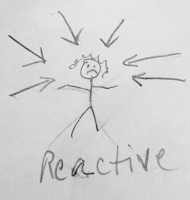
Why do these two distinctions matter? If we believe that we are in control of our lives and the things that happen to us (internal locus of control), then we will take the necessary steps to address problems or find solutions. We believe that we retain the power to effect change. If we allow an external locus of control, then we are more likely to view ourselves as victims and powerless to solve our problems. We focus instead on reacting to the world around us. I call this, "being buffet by the winds of fate and change."
Stephen Covey 7 Habits of Highly Effective People
Reactive: Victim, Helpless

When we consider what our current situation or problems are, then we squarely face what is in front of us. We hone our focus and turn our direction toward the personal and direct. We own our situation. We own our complaints. We own our problems. Our thoughts become more acute and realistic about what is happening in our lives.


Dr. Covey reminds us that we are responsible for our lives. One of my favorite books, The Non-Runner's Marathon Trainer, discusses this subject in one of the early chapters. The runner's book frames the issue as one of the perception of control -- where we think the locus of control for our lives resides. If we believe that we are in control of what happens to us, then we have an internal locus of control. If we think that control for what happens to us lies comes from others or forces outside of our control, then that is an external locus of control.


How to Recognize Proactivity

Dr. Covey reminds us that we are responsible for our lives, that we have the "response-ability" to make our lives what we want them to be. Here are some ways to recognize proactivity:

  • We understand that we are responsible to make things happen, and we take the initiative to do what needs to be done.
  • We understand that we can choose our own actions, and even if we are unable to change or do something, we still retain the ability to choose how we will respond to the situation.
  • We understand that we can work in small areas and groups. We can work to be proactive in smaller, more focused areas of our lives and then branch out to wider areas of concern.
  • We understand that we can focus on our "circle of influence" rather than our "circle of concern." We can change what we are able to change rather than be pulled to change something that is outside of our control.
  • We understand that mistakes happen, and we learn from these errors. A proactive approach means that when we make mistakes, we correct the errors and then learn the lesson we can take from the mistake.
Widen the Space

One of my favorite Stephen Covey quotes is:
"[T]here is a gap or space between stimulus and response, and . . . the key to both our growth and happiness is how we use that space."
I offer this quote as a reminder that whatever happens in our lives -- whether we truly retain the power to control or effect change -- we will always retain the ability (response-ability) to choose our response. There is a gap or space between what happens to us and how we respond. We will be wise to widen that space as much as we can to allow ourselves the time we need to choose -- proactively -- the best response.

Building the Proactive Habit

So let us look at how the habit Be Proactive might look in the context of Suzuki teaching and parenting. How could we put this habit into practice?

First of all, make a list of those areas of your Suzuki life that may be less than satisfying. Perhaps as a teacher, you think that your students do not practice enough or that your studio parents do not follow the program as closely as you wish they did. If you are a parent, perhaps your child does not want to practice or do the work that you think he or she should do to prepare adequately for lessons. Or, perhaps you are a parent who has difficulty making adequate time for practice with your child on a daily and consistent basis.

What are the typical reasons you offer to explain why these problems occur in your life? Write down a list of the reasons you give. Then take a hard look at what you have written. If I were to tell you that it was your fault that these problems occur, what would you think? How would you approach the situation then? Let us take a closer look at the typical problems that I wrote above. I suggest that you write down what you discover.
  • Inadequate practice: What is your response to this? How do you handle this situation?
  • Unengaged parents: How do you approach the parents to discuss alternative behavior?
  • Reluctant students: How have you allowed your children to be rewarded for undesired behavior?
  • Over-scheduled parents: What are your reasons for failing to say "no" to a schedule that is too busy? How can you frame your priorities in a way that allows you to build a schedule that is more relaxed and productive?
You may answer the above questions with many possible solutions. The idea here is to frame the questions in such a way as to turn our focus toward how we can structure or explain things differently. We want to believe that we can make changes and control the way things happen. Each of these beliefs, attitudes, and spurred calls to action represents the proactive approach, which feels pretty darn good. These approaches also turn our focus to solutions rather than problems or complaints. We will diminish the attitude of helplessness and happenstance and instead increase our expectations of promise and purpose.

Signs That We Are Not Proactive

As part of my in depth look at habit one and proactivity, I considered easy ways to recognize when we were not focusing on habit one. Here are two things I watch for:
  • Complaining: When we complain, we generally make noise to someone who lacks power to make any change, and we do not point ourselves in the direction of doing anything about the problem. Complaining is easy and involves little work. Actually doing something about the problem would be proactivity.
  • Overusing objective pronouns and weak verbs: When we are not proactive, we rely on objective pronouns, such as you, he, she, it, them, me, or us rather than I or we. When we are proactive, our language reflects this attitude. We use action verbs. We put ourselves as the subject. We are the heroes in our lives. Any other type of pronoun indicates that we are sitting back and allowing others and circumstances to control us rather than taking charge ourselves.
Self-Reflection Questions (Proactive)

To set yourself up for success with habit one and being proactive, I urge you to create a system that will allow you regular and consistent time to do some self-reflection. Whether you journal, write morning pages, pray, or meditate, some sort of system that encourages you to sit quietly to reflect and consider the state of things will help you to shore up your habit one proactive skills. Get in the daily habit of asking and answering these types of questions, which are designed to turn your focus to identifying what you can do to alter your current situation and achieve your own priorities:
  • What did I accomplish?
    • What were my successful strategies?
    • What were my stumbling blocks?
    • How could I change my approach to use more successful strategies and avoid or overcome obstacles?
  • What lessons did I learn from my success or difficulties?
  • What things puzzled me?
  • What am I grateful for?
  • What am I 100% committed to do tomorrow?
Let me remind teachers and parents that what we do in the Suzuki method is so much larger than ourselves as individuals. What we do today with our students and children will have lasting impact on the future civilizations of our world. This mission is important enough to require us to spend time and focus working on our ability to use habit one to be proactive.

Most important of all, when you focus on building up the proactive habit, notice whenever you think about problems as somehow being someone else’s fault or the product of some world circumstance. When your thoughts turn this way, develop the habit of stopping at that moment to recognize that you and your thoughts are the problem there.

Until next time,


Happy Practicing!

----- Paula -----


© 2017 by Paula E. Bird

Monday, August 14, 2017

What is Your Habit Plan?

Stop the habit of wishful thinking and start the habit of thoughtful wishes.
-- Mary Martin (Broadway actress and singer)

Stephen Covey wrote a terrific book about 7 habits that he identified in highly effective people. I began a podcast series for Suzuki teachers and parents based on Dr. Covey's book but related to the types of issues that we Suzuki teachers and parents face. I thought it would be helpful to write summary blog articles as companions to the podcast episodes.

If you want to follow along with the actual podcast and the introductory episode, click here: Introduction to 7 Habits of Highly Effective Suzuki Teachers and Parents.

In the first episode of the podcast series, I spent some time discussing the subject of habits. I believe that if we understand how habits are created, we will do a better job of creating and maintaining habits that will lead us to success. We will avoid falling into the trap of bad habits because we will be aware of the types of behaviors that might lend themselves to unwanted habits.

I highly recommend two books that provide very helpful information about habits:


I based my podcast series on Dr. Covey's book about the 7 habits. Dr. Covey includes a great deal of information, thoughtful insight, and interesting stories in his book, which I was unable to include in my own discussions in the podcast and blog articles. I highly recommend this book to be a part of everyone's library.


Charles Duhigg wrote his fascinating book about how we form habits, and I found the stories and information very interesting to read and think about. Within the first chapters, I already recognized most of my students' behaviors as they related to bad practice habits. After reading this book, I finally understood why my students and I struggled to create and maintain good habits. The book is structured around stories that are self-contained. I read the book over a long period of time, and I found that with every story -- whether corporate or individual -- I learned something useful that I could use in the teaching arena as well as in my personal life. A best-selling book (and for good reason!), I will keep this book on my bookshelf of teaching resources.

One of the first things I reflected on after reading the Duhigg book were those behaviors that I engaged in frequently but without much awareness. I often remark to my studio parents and university students that when we do something one time, it can be an accident or a once-in-a-while thing. Once we engage in the same behavior a second time, then we are on the threshold of initiating a habit. A third time? Good luck now, because we are already well down the road of habit formation.

Be Mindful

As I reflected on the scary thoughts of how easy a person can create a habit and that our brains are wired to build habits and routines in order to conserve mental energy for more important things, I spent more time being mindful of the habitual behaviors I engaged in. I made a list as I worked through a typical day. I was astonished, as you will be, by the sheer volume and number of habitual little behaviors we engage in with little to no conscious thought or awareness.

Not all habitual behaviors are bad. Some are good behaviors to cultivate. My advice is to become mindful so that you can devote more time and attention to support the good behaviors and to eliminate the undesired habits and routines or supplant them with new ones. Mindfulness was the first step.

Be Positive

I also spent time thinking about the attitude I brought to the exercise. Was I thinking of my habits as negative or positive? I recently listened to a TED Talk video about how difficult it is to change a negative attitude into a positive outlook while we can easily change a positive attitude into a negative one. My next step was to turn my habitual thinking and attitudes into positive outlooks. I ceased to think of my problems as stumbling blocks and instead reframed my thinking about problems and difficulties as merely things that need to be taken care of first in order to reach my ultimate goal. When I think of difficulties as preliminary steps on my habit journey, I find that I can more easily maintain my good attitude and consider a different approach.

Be Analytical

My third step was to go through a special analysis to develop the kind of habits that I wanted to create or maintain in my life. This analysis led me to a four-step process.
  1. Identify Behaviors 
  2. Build a Plan
  3. Take Action
  4. Evaluate
I began with exercises to identify behaviors and routines that I wanted to continue, eliminate, or change. I tried a variety of techniques to identify these sorts of behaviors. I thought about the areas of my life that dissatisfied me or made me feel uncomfortable. Those feelings helped me to build awareness of areas in my life that needed habit work. Sometimes I added the techniques of brainstorming or mindmapping to gather and sift through ideas. I picked one thing to work on at a time, and I carefully considered whether my habit goal was clear and specific. I made sure that I turned my bigger goal into a series of measurable small steps that I could follow that were within my control and would inevitably yield results over time.

I would then build a plan to follow with the list of steps I would take toward my goal. I found that I could accomplish a goal much easier if I built a plan around a series of small steps rather than some vague sense of working toward a goal. For example, I may not lose 10 pounds in two months by framing my goal in that way, but I am more likely to achieve that goal if I step on a scale daily, walk 30 minutes or run daily, measure and keep track of my food, and write everything down. If I do all of these steps or at least achieve a minimum level for each step, then my success is more likely to occur.

The most important step after building a play was to take action on the plan. I began to execute my plan. I did not wait until I thought my plan was perfect. I took immediate action. I did not wait until the next day or some nebulous and uncertain future date to get started. In fact, I frequently asked myself, "why not start today?" Why not take the momentum and excitement of the current moment and slingshot it into the first action steps?

Review is the most important part of any habit exercise. If we reflect on what we have done, consider the reasons for our success or failure, identify any good or bad patterns of behavior, and renew our commitment to the ultimate goal or habit, then we have the best chance of success. We will learn from our behavior and be mindful about the reality of our situation. Review is extremely important, and I recommend that you set aside a regular period of time to reflect.

Finally, build on your experience. Add new things. Build on old things. Experiment with mini 30 day challenges and allow your experience to grow into a larger experience. Have patience with yourself as you journey along your habit road.

Until next time,


Happy Practicing!

----- Paula -----


© 2017 by Paula E. Bird

Friday, July 14, 2017

7 Habits of Highly Effective Suzuki Teachers & Parents

Stephen Covey wrote a book called The 7 Habits of Highly Effective People. This powerful book has been around a long time and is still popular, because Dr. Covey's book relates information that is timeless and valuable. Dr. Covey studied the "success literature" in order to glean the lessons that pertained to building and strengthening our character at its core, and the result of his study were 7 habits.

As my readers know, I am fascinated with the development of our personal character. I have written about this important subject many times (Rock or Sand -- Shifting Priorities) (Enliven Technique with Basic Goodness). This area of personal development is so important, that I think we need to spend daily time reflecting on how we can improve ourselves in this area. As I reviewed my copy of Dr. Covey's infamous book, I began to think of ways that this subject could relate to Suzuki teachers and parents. How would the seven habits look from the perspective of the Suzuki Method?

I began creating podcast episodes for each of the seven habits along with an introduction about habit formation in general. You can find the Teach Suzuki podcast on iTunes or whichever is your podcast provider. I thought it would be helpful to follow along with the podcast series in the blog as well for those folks who prefer reading rather than listening.

So stay tuned in the coming weeks, as I post articles that correspond to the podcast series about the 7 Habits of Effective Suzuki Teachers and Parents. If you want to listen to the podcast in advance of the blog articles, you can find the following episodes here:

The 7 Habits of Highly Effective Suzuki Teachers & Parents (introductory episode)

Habit 1: Be Proactive | Take Charge


Habit 2 (Begin with the End in Mind | Scrooge & the Future Ghost) will be released on Sunday, July 16, 2017, at 3 p.m. CST. If you wish to subscribe on iTunes, click here. The podcast is well over a year old now and has over 100 episodes.

If you would like to follow along with the series in Dr. Covey's excellent book, click here (affiliate link: no extra cost to you but small benefit to the blog).

Until next time,


Happy Practicing!

----- Paula -----


© 2017 by Paula E. Bird

Thursday, May 26, 2016

Watch Your Language

"I can't do it!"

"I'm so stupid!"


"I'll never be able to get this!"


"I'm just not very good at this."


When I trained for the marathon in 2005-6, I learned that it was imperative that I keep my mind in a positive mode. I found it easier to stay the course in my training and discipline if I kept my mind in a healthier, more upbeat place, because whenever any negativity entered into my sphere, I noticed that it had a detrimental effect on my psychological ability to push through and keep going.

During my training, I picked up many helpful tricks to stay in this happier mental state, and I found these tricks quite useful in the musical arena as well. Most of these simple tricks related to a simple tweak in my focus and awareness of the language I chose to use aloud and to myself.

"You can do this, you know you can."
Watch your language, choose yes
Yes!

"You're a person who perseveres when things get tough."

"You have the discipline and strength to finish this."

"You are prepared for this, so relax and let the training take over."

I said these affirmations, especially the first one, frequently every day. What I discovered is that the affirmation would pop into my head several times all on its own. It became a part of my self-talk on a regular basis, and I noticed that my attitude stayed positive and strong as a result.

But how do we get to this stage? For some of us, our self-talk has dipped so low, that we are unaware of how weighty it has become. It pulls on us, gnaws on us, and ultimately drags us down to an unpleasant place where things seem so hard and impossible to accomplish. How do we fix this negative self-talk habit? I have a few suggestions.

Here are three easy steps that you can take to help you notice and change your language choices.

Change your Physical State

Changing our physical state will often change our mental state. For example, when I am angry or frustrated, I notice that my shoulders, upper back, and back of the neck are tense. I hold my breath. When I adjust these tension points and take a slow breath out and then in, my mental attitude responds as it relaxes and drifts toward a more positive state.


Notice what your physical state is the next time you catch yourself saying something negative. Are you holding your breath? Are you squeezing a muscle somewhere in your body? Are you clenching anything? Are you smiling? Whatever you are doing, change it to something else. I find that smiling is the fastest way to change a negative physical condition. I make it a practice to smile at the top or bottom of every flight of stairs at work, from the initial stairway that leads down to the front door of my workplace to the inner staircase that connects both floors of the building. Every time I reach the bottom or top of the staircases, I remind myself to smile. This is a habit that I have built over time, and I think that it has helped immensely to alter my face into a happier one when I greet my colleagues and students within my workplace.

But it Doesn't Matter

This suggestion comes from one of my favorite books. Although this book is devoted to marathon training for non-marathon runners, I find that much of the book has some very useful tips for musicians. The book, Non-Runner's Marathon Trainer by David Whitsett, Forrest Dolgener, and Tanjala Kole, has three parts to each chapter:
  • The first part is devoted to the psychological or mental aspect of training and preparing for a marathon.
  • The second part advises things related to the physical aspects of training.
  • The third part recounts personal stories and advice from runners involved in the training program.
What I found most helpful in this book from a musician's standpoint was the psychological discussion at the beginning of each chapter. When it comes to altering your language choices or focus, I highly recommend this book as one of the tools you might use because of its wealth of information contained at the beginning of each chapter. And the training program (4 runs per week) is pretty darn good too.

One very useful suggestion from the marathon training book was the phrase, "but it doesn't matter" placed at the end of every complaint or negative thought. For example, I might start whining because I am having trouble with my coffee pot. "But it doesn't matter!" I will exclaim. Then I will argue with myself for a few more sentences: "yes it matters! I need to have my coffee in the morning without fussing with the coffee pot!" I pause and remember what I am supposed to do. "But it doesn't matter," I will remind myself to say aloud.


It really does not matter unless you believe it does, and by reminding yourself that it does not matter, you will remind yourself to overcome whatever frustration is in this moment. Since we routinely overcome many such problems in our lives, this teensy reminder goes a long way to refocus our attitude, belief, and view of ourselves -- that we can do this. After reminding myself a few times that my complaints really do not matter, I will notice that my body completely relaxes with the change in thought and attitude.


Modify Your Behavior (the Positive-Negative Marble Jars)


One studio family came up with a clever idea to help modify their child's language behavior. The daughter was in the habit of arguing a lot without really meaning to argue. She would enter into conversations with a conflicting viewpoint, or she would answer "yes" and then follow it up with "but" or "no." Her parents came up with a behavior modification scheme to help the daughter to recognize when she was doing these types of behaviors, and the parents helped her to find a concrete way to record these negative or positive behaviors. The parents hoped that by recording the language choices the daughter made, that the daughter would then refrain from the unwanted negative language in favor of positive responses. Instead of saying, "no," "but," an excuse of any kind, or any other negative words, the parents encouraged her to say, "yes, and," "okay," and "may I" instead. For example, here is a possible conversation before the behavior modification scheme:


Parent: "I think it's going to be a nice day."

Child: "Yes, but it's going to rain later."

Teacher: "I think your left hand could be more relaxed so that your wrist is flatter rather than bent."

Student: "But I'm holding it relaxed!"

Parent: "Can you take out the garbage later?"

Child: "No."

If you notice, there would not be much to say after those brief exchanges. After the behavior modification, the above conversations might go like this:


Parent: "I think it's going to be a nice day."

Child: "Yes, and it might rain later too."
Parent: "Oh that might complicate things! We do need the rain for the garden though."

Teacher: "I think your left hand could be more relaxed so that your wrist is flatter rather than bent."

Student: "Okay, let me try that. Does this work better?"
Teacher: "Yes, that's better. Can we work together to see if your wrist can relax even more?"

Parent: "Can you take out the garbage later?"

Child: "May I do it after dinner rather than right now?"
Parent: "Of course, that would be a terrific help!"

Notice that it feels more comfortable to continue with the conversation when there are positive responses.


Here is a picture of the positive-negative jars that the parents used to help their daughter become more aware of the language choices she made. If the daughter said something negative or positive, then she would put a marble in the appropriate jar. Notice how many positive marbles there are after only a few days of this exercise! At the next lesson, the daughter was very eager to tell me the exact number of positive versus negative marbles that she had in her jars.


marbles in jars to modify behavior
Positive and Negative Marble Jars

One of my other posts discussed what a performer might say after a recital or other performance. If you would like to read that post, click here.


If you are interested in the marathon book, click here. Please note that this is an affiliate link, meaning that it will be no additional cost to you and you are under no obligation to purchase this item, but if you are already in the market to buy this book, I will get a financial benefit that will go to support the blog and the production of the podcast. I appreciate your help so that I can avoid putting advertisements on the blog.

As a reminder too, if you have not yet subscribed to my newsletter, please do so or send me an email and I will add you to the mailing list. At the moment I send the newsletter out twice a month and include links to articles and podcast episodes that you may have missed. As always, I greatly appreciate my readers and all of their helpful suggestions and comments!


Happy Practicing!

----- Paula -----


© 2016 by Paula E. Bird


Thursday, December 3, 2015

Quick Practice Tip: Rate Your Day

Here is a practice tip that might help you to find motivation to practice or to perform any desired habit. Set up a system to rank yourself each day. Here is how it works.

For this example, let us say that I am trying to lose weight. I set up a list of what I consider to be good health habits that when I follow them, I would be likely to lose weight. These habits could possibly include things like:

  • weigh daily on a scale (1 point)
  • log all food intake in a journal (1 point)
  • stay within a daily calorie limit (1 point)
  • meet any or all of the three Apple Watch activity goals (1-3 points)
  • accomplish any 20-minute period of exercise beyond the 30 minutes recorded by the Apple watch (1 point each 20-minute period)

Then I would give myself a point for performing any of the habits and thereby rating my day. I would keep a calendar that recorded my progress on these habits. I would suggest setting a minimum threshold ranking number and strive to at least attain that number.

How would this work for practice scenarios? How about making a possible list of habits to earn points from these areas?

  • playing a scale or scale assignment
  • playing a review song
  • practicing 30 minutes
  • any 15 minutes practicing beyond the initial 30 minutes
  • playing a repertoire piece
  • practicing a preview exercise or 5 minutes of a technical exercise or etude
Then I would set the minimum threshold points goal at 3, because it would be "easy" to gain points for doing a scale, review song, and 5 minutes of a technical exercise. That would be a possible 10 minutes. I firmly believe that everyone can find 10 minutes in even the busiest day.

Let me know if you try this idea and what you discover that helps. I have successfully used this technique for several months now, and I find it very encouraging to reinforce good habits.


Sunday, July 19, 2015

How to Recover from a Practice Break?

I have been away for a while (trips to China and Italy). Now I’m back and in the midst of summer camps. I have fit a few of my studio lesson students into my schedule as I could. I found that most of them, if not just about all of them, took a break when I was not around. This put an enormous burden of responsibility on my shoulders, because the clear message that I got from this realization was that if I did not offer lessons every week, then my students or their parents did not take on the responsibility of maintaining a practice schedule on their own. In other words, if I am not here to monitor them or provide a reason to practice, then the practice did not happen because my students and their practicing partners could not do this for themselves.

Well, that is no fun for me! I had other thoughts about this phenomenon as well. How come there is such a mismatch of expectations? Why are our belief systems about lessons and music education so different? Are everyone’s lives so very busy that a simple practice schedule cannot be followed? But, this is probably a different article than the one I wanted to write here.

I understand completely the need to “take a break.” I have those same thoughts myself. Mostly I have discovered that when I have that feeling, I may merely need to make a change in what I do. I find that a change is a better plan than stopping what I do completely. For example, if I am complacent (a much better word than tired or bored!) about a particular healthy breakfast that I eat every day, I find it serves me better not to stop eating a healthy breakfast but to substitute another healthy meal in its place. If I want to maintain a writing habit, then I change up what I write about.

If I am complacent about my practicing or schedule, then I will keep up the practicing (and maybe the schedule) but change the makeup of what I do. I will substitute in some different style of music for my usual fare. Rather than a dry diet of etudes, I might add in some popular music or some fiddle tunes. I might practice my reading skills by playing new music or playing chamber music with some friends.

There are other things to try as well, such as inviting other musical friends over for a music party. Have a pool party and play-in or a friendly barbecue with other families. One of my students set up a special recital and made plans to perform many pieces that required her to practice quite a bit. Another student signed up to attend the local institute, and she has been busy practicing her orchestra music and reviewing her list of institute pieces. Other students attended summer strings camps and practiced for the orchestra placement auditions. Other students have signed up to perform for school events that happen at the beginning of the fall semester. Others have practiced to play for special performances at nursing homes or charity events. There are many possibilities rather than taking a break.

Of course, there are the unavoidable life events. The family might take a trip that may be too dangerous to take a violin along. One family wisely left the instrument at home, and later suffered a wild horse stampede through their campsite. Good thing the violin was safely at home. Even in circumstances like this, there may still be some other options to consider. When there is a passing of a relative or close friend in the family, the student might be willing to participate in the memorial services. Sometimes the act of maintaining a practice schedule helps the family to “hold it together.” I still remember vividly the day of 9/11 when one by one my students arrived at the studio throughout the day (I had been teaching the morning of the tragic event). As each parent poked his or her head in the studio door to ask if I was teaching that day, the parents and I would look at each other with that sad knowledge that the world had changed in a big way, while the act of teaching and learning continued its regular course in the perspective of the students. This was the best gift that my parents and I could give the students (and ourselves) at the time.

So how does one recover from a practice “break”? This seems like a silly question, except that the summer is half over, more so for some of us since school resumes in a few weeks here in the South. Whatever we have not accomplished by this point needs to be addressed now. I have written about this subject before (Getting Started After a Break, The Summer Challenge). Here are a few suggestions:

Listen to repertoire pieces daily, old and new. Nothing works quicker to bring back the spark in your student’s playing than hearing the songs that the student is learning. If you are going to take a trip that involves leaving the violin at home for a brief time, make plans to do some daily listening.

Daily practice. Even a short period of time or perhaps a few small daily practice sessions will be easy. The first few days will be the hardest because you will be working to overcome what I call "practice inertia" -- the tendency to continue moving (or not moving in this example) in the direction you have been moving. Merely set yourself a small time goal (5 minutes might be the starting point) and allow yourself and your student to expand that time period as the going gets easier. When you know that you are permitted to quit after 5 minutes, it becomes easier to stay the course and play for 10 or 15 minutes. From that point, you will find it easier to start focusing on a practice session to achieve particular goals rather than time.

Focus on posture. When we take a break, we may find it easy to fall into bad habits. We forget the correct way to do things, and we begin to do “easy” things, which are basically posture issues gone way wrong. Take the time to focus on correct posture all the time. I like to remind my students that it is as easy to perform a habit correctly as it is to perform it incorrectly. The bad habit merely feels easy when in fact it is not because it will involve major problems later.

Do lots of review. Review is a great way to ease back into a regular routine because it focuses on things that are already familiar. If your student has forgotten material learned earlier, then your student will become frustrated with new material for sure. Focus on reviewing earlier songs until your student remembers the correct posture and the earlier material. Then moving onto new material will be easier.

Set a schedule and follow it no matter what. Part of forming a good habit is to set a schedule for it and set up reminders so that you maintain the schedule. If you set up a schedule, then follow it. Make the schedule be a daily thing so that it remains easy to follow. I call this scheduling for the inertia factor. If you are already following a daily schedule, it is easier to keep following the schedule and harder to skip. See one of my earlier articles about the power of routine.

Keep it simple. Whatever you decide to do, keep your plans simple at first. It is easier to begin small and build a good routine and then later expand the routine than it is to be too ambitious and then become too overwhelmed to follow your plan. Start small and simple and grow from there.

Sometimes it is nice to enjoy the good weather and the summer activities. While you are enjoying your summer activities, keep in mind that one purpose of music education is to teach students life lessons such as discipline, perseverance, and skill development. Coming back from a vacation break can be a good time to reinforce these life lessons as you and your child get back on track. Give a nod to summer by keeping practices short and sweet, but also show your child how to get back on track with the rhythm of practice and learning.

Enjoy the rest of your summer break!