Quantcast

Search This Blog

Showing posts with label 7 habits. Show all posts

Tuesday, June 25, 2019

Making Excuses is a Bad Habit

The following article was originally published on June 11, 2012. Here is an updated version.

I find it fascinating that we humans spend an inordinate amount of time inventing creative excuses to avoid something, like work. I am amazed at how creative our excuses can be and how much of a habit excuse-making can be for many people.

What is an excuse? An excuse is something we put forward as a way to justify, explain, or excuse something we feel guilty or responsible for. An excuse is not only a reason to justify or explain away something we may have done wrong, but it is also a reason we put forth to justify why we should not do something that we know we should do.

Excuses may be part of the natural human condition: we tend to avoid work. There may be a few of us out there who thrive on working hard at all times, but for most of us, work is something we have to do and we try to find ways to avoid it or make it easier. I understand this. Really, I truly do, because I myself do the same thing. There are aspects to my life where I try to avoid the work associated with it, such as housecleaning, filing my tax returns on time, or cleaning out the refrigerator. We will have moments such as these in our lives. As long as I have determined that the excuses I allow relate to activities that do not claim a high priority for me, I can live with that.

What really astonishes me is the number of parents who have made excuse-making a general habit in terms of lessons, practicing, or learning and ability development. I am disturbed as a teacher to recognize that the young students copy (and therefore perpetuate in the future) these same excuse-making behaviors. When parents make excuses for their children to avoid work to learn an important skill or develop a high level of ability, I wish that parents would not be in such a close or easy relationship with excuse-making.

I study Stephen Covey's 7 Habits of Highly Effective People. Habit 1 of the 7 habits is to be proactive. This first habit refers to our ability to choose how we react to something. Originating from a quotation by Victor Frankl (a WWII prisoner of war), Stephen Covey writes: "Between stimulus and response there is a space. In that space lies our freedom and power to choose our response. In those choices lie our growth and our happiness."

We have the ability to choose our response. We have the ability to decide what our reaction shall be. We can build the habit of widening the space between stimulus and response so that we have the time to choose wisely what our response shall be. We can choose to be happy. We can choose to avoid other behaviors or responses that do not lead us to happy and productive results.

There are many things in today's world that compete for our time and attention, and there are some things we have little or no control over. One subset of things that compete for our attention contains those activities that we can exercise some control over. We need to focus on this subset. If we waste our efforts and work in areas in which we have no control, we will beat our heads against the wall, feel frustrated and defeated, and generally waste a lot of our time and energy. Instead, if we focus our efforts over areas that we can exercise control, we will generate feelings of satisfaction, success, and self-confidence.

When we waste our time and energy to create excuses, we do not strengthen any productive character traits. Instead, we build reasons why we do not have to try, succeed, or work at something. I do not want to go through life giving reasons why I cannot succeed at something. Instead, I want to hold my head up high because I have actually accomplished something. If I make excuses, I am not accomplishing anything other than to add more empty words to the atmosphere around me.

Here are some typical excuses I might hear from parents during the week [along with my personal observations]:
  • We forgot our books. [again!]
  • How come we are taking so long to get through the theory book? [You have forgotten it every week for a month because your child misplaced it under his bed].
  • We had a busy week. We just couldn't find any time to practice. [not even 5 minutes, but you found time every day to watch television or play video games].
  • My child gave me a hard time when it came to practicing, so we didn't practice. [The child runs your house].
  • My work schedule changed and we could not have successful practices. [You cannot figure out how to fit practice into your new schedule].
  • My child's schedule is too busy to find adequate time to practice. [or you don't feel like taking control of your child's schedule].
  • I didn't understand the assignment. [and apparently do not understand how to use the phone, write an email, or send a text message to ask for clarification].
  • The child's instrument was out of tune. [and you could not find time to telephone the teacher so she could help you tune it over the phone.]
  • I am tired of listening to my child's practice. Does she have to keep playing the same song? [in other words, do I really have to listen to my child repeat things until she learns them? Yes, you do. I would expect parents to enjoy watching their children learn and grow.]
  • Do I have to listen to my child's daily practice? [Yes. Why would you not want to spend time with your child?].
  • I can't get my child to practice or repeat things for me like he does for the teacher. [You have not taken the time to reflect on why this is so].
  • I can't be on time to lessons [again]. I seem to run into things that hold me up. [time and again]. [In this case, I fear that even if I were to set their lesson 15 minutes later, they would still show up 15 minutes late. Maybe I should tell them that their lesson starts 15 minutes earlier and then expect the lesson to actually begin 15 minutes later? It would be a problem though if one day they actually did show up on time to discover that I would then be "late"].
  • I forgot __________. [Forgot what, you ask? Just fill in the blank.].
  • My other children had something that interfered with my child's schedule. [If this is a frequent excuse, then the student's activities seem to rank lower in priority than the other children. There may be occasional unforeseen circumstances, but I refer here to family situations where this has become a routine or habit].
  • We had out-of-town company [and we couldn't figure out how to turn this visit into a performance opportunity or a chance to encourage the out-of-town company to join the Suzuki community].
A while ago I wrote a post about whether we are a W, C or E. (click here to read). The W stands for Whining, the C for Complaining, and the E for Excuse Makers. There are some helpful tips in that post about how to transform a W, C, or E personality into something that is more productive and less excuse-ful.

Let us commit to stop making excuses. Let us each choose to say "I'm sorry," and then address the problem personality trait and behavior. When we refuse to acknowledge a mistake or a failure on our part to do something we ought to do — when we make excuses — we also refuse the possible gift and opportunity to perfect our mistakes. If instead we refuse to give excuses and choose instead to acknowledge and correct our behaviors and bad habits, we can then focus on actually accomplishing something.

Parents (and teachers), be careful that you empower your children (and students). Examine carefully the excuses you make. Here is a powerful example of the negative impact that excuses can have on our ability to develop talent and on our belief that we have the control to make this ability happen:

"I was not born with enough talent to be great."

"Talent is not inborn."

Dr. Suzuki actually made both of these statements in his book, Ability Development From Age Zero. Fortunately, Dr. Suzuki recognized the debilitating falseness of the first statement, which limited his efforts to develop talent and foster a belief in the results of his efforts. The second statement sets up the basis for success because it reminds us that the power to develop ability lies within us.

As long as we do not make excuses.

He that is good for making excuses is seldom good for anything else. — Benjamin Franklin

The Teach Suzuki Podcast recently published an episode that looks at the issue of excuses in a different way: Episode 168: So What? 

Until next time,

Happy Practicing!

----- Paula -----

© 2019 by Paula E. Bird

Monday, August 21, 2017

Habit 1: Be Proactive | Take Charge & Widen the Space

Stephen Covey 7 Habits of Highly Effective People
Habit 1: Be Proactive | Take Charge
I recently began a series of podcast episodes the habits of effective Suzuki teachers and parents, based on the work of Stephen Covey. If you would like to follow along with the podcast habit episodes and blog articles, here are the links:

Habits of Highly Effective Suzuki Teachers & Parents (podcast & series introduction)

What is Your Habit Plan? (article about habit series introduction)

Habit 1: Be Proactive | Take Charge (podcast)

What Does Proactive Mean?

Stephen Covey's first habit is to be proactive. When I looked up the definition of the word in the Merriam-Webster Dictionary [“controlling a situation by making things happen or by preparing for possible future problems”]. I found two words in the definition that made me pause to think: making and preparing. These words are action words. These words require us to do something, not be something or observe something, but to get up and perform some action. The definition of the word "proactive" points us in the direction of action.

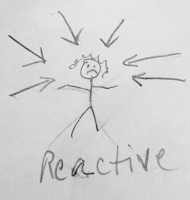
Why do these two distinctions matter? If we believe that we are in control of our lives and the things that happen to us (internal locus of control), then we will take the necessary steps to address problems or find solutions. We believe that we retain the power to effect change. If we allow an external locus of control, then we are more likely to view ourselves as victims and powerless to solve our problems. We focus instead on reacting to the world around us. I call this, "being buffet by the winds of fate and change."
Stephen Covey 7 Habits of Highly Effective People
Reactive: Victim, Helpless

When we consider what our current situation or problems are, then we squarely face what is in front of us. We hone our focus and turn our direction toward the personal and direct. We own our situation. We own our complaints. We own our problems. Our thoughts become more acute and realistic about what is happening in our lives.


Dr. Covey reminds us that we are responsible for our lives. One of my favorite books, The Non-Runner's Marathon Trainer, discusses this subject in one of the early chapters. The runner's book frames the issue as one of the perception of control -- where we think the locus of control for our lives resides. If we believe that we are in control of what happens to us, then we have an internal locus of control. If we think that control for what happens to us lies comes from others or forces outside of our control, then that is an external locus of control.


How to Recognize Proactivity

Dr. Covey reminds us that we are responsible for our lives, that we have the "response-ability" to make our lives what we want them to be. Here are some ways to recognize proactivity:

  • We understand that we are responsible to make things happen, and we take the initiative to do what needs to be done.
  • We understand that we can choose our own actions, and even if we are unable to change or do something, we still retain the ability to choose how we will respond to the situation.
  • We understand that we can work in small areas and groups. We can work to be proactive in smaller, more focused areas of our lives and then branch out to wider areas of concern.
  • We understand that we can focus on our "circle of influence" rather than our "circle of concern." We can change what we are able to change rather than be pulled to change something that is outside of our control.
  • We understand that mistakes happen, and we learn from these errors. A proactive approach means that when we make mistakes, we correct the errors and then learn the lesson we can take from the mistake.
Widen the Space

One of my favorite Stephen Covey quotes is:
"[T]here is a gap or space between stimulus and response, and . . . the key to both our growth and happiness is how we use that space."
I offer this quote as a reminder that whatever happens in our lives -- whether we truly retain the power to control or effect change -- we will always retain the ability (response-ability) to choose our response. There is a gap or space between what happens to us and how we respond. We will be wise to widen that space as much as we can to allow ourselves the time we need to choose -- proactively -- the best response.

Building the Proactive Habit

So let us look at how the habit Be Proactive might look in the context of Suzuki teaching and parenting. How could we put this habit into practice?

First of all, make a list of those areas of your Suzuki life that may be less than satisfying. Perhaps as a teacher, you think that your students do not practice enough or that your studio parents do not follow the program as closely as you wish they did. If you are a parent, perhaps your child does not want to practice or do the work that you think he or she should do to prepare adequately for lessons. Or, perhaps you are a parent who has difficulty making adequate time for practice with your child on a daily and consistent basis.

What are the typical reasons you offer to explain why these problems occur in your life? Write down a list of the reasons you give. Then take a hard look at what you have written. If I were to tell you that it was your fault that these problems occur, what would you think? How would you approach the situation then? Let us take a closer look at the typical problems that I wrote above. I suggest that you write down what you discover.
  • Inadequate practice: What is your response to this? How do you handle this situation?
  • Unengaged parents: How do you approach the parents to discuss alternative behavior?
  • Reluctant students: How have you allowed your children to be rewarded for undesired behavior?
  • Over-scheduled parents: What are your reasons for failing to say "no" to a schedule that is too busy? How can you frame your priorities in a way that allows you to build a schedule that is more relaxed and productive?
You may answer the above questions with many possible solutions. The idea here is to frame the questions in such a way as to turn our focus toward how we can structure or explain things differently. We want to believe that we can make changes and control the way things happen. Each of these beliefs, attitudes, and spurred calls to action represents the proactive approach, which feels pretty darn good. These approaches also turn our focus to solutions rather than problems or complaints. We will diminish the attitude of helplessness and happenstance and instead increase our expectations of promise and purpose.

Signs That We Are Not Proactive

As part of my in depth look at habit one and proactivity, I considered easy ways to recognize when we were not focusing on habit one. Here are two things I watch for:
  • Complaining: When we complain, we generally make noise to someone who lacks power to make any change, and we do not point ourselves in the direction of doing anything about the problem. Complaining is easy and involves little work. Actually doing something about the problem would be proactivity.
  • Overusing objective pronouns and weak verbs: When we are not proactive, we rely on objective pronouns, such as you, he, she, it, them, me, or us rather than I or we. When we are proactive, our language reflects this attitude. We use action verbs. We put ourselves as the subject. We are the heroes in our lives. Any other type of pronoun indicates that we are sitting back and allowing others and circumstances to control us rather than taking charge ourselves.
Self-Reflection Questions (Proactive)

To set yourself up for success with habit one and being proactive, I urge you to create a system that will allow you regular and consistent time to do some self-reflection. Whether you journal, write morning pages, pray, or meditate, some sort of system that encourages you to sit quietly to reflect and consider the state of things will help you to shore up your habit one proactive skills. Get in the daily habit of asking and answering these types of questions, which are designed to turn your focus to identifying what you can do to alter your current situation and achieve your own priorities:
  • What did I accomplish?
    • What were my successful strategies?
    • What were my stumbling blocks?
    • How could I change my approach to use more successful strategies and avoid or overcome obstacles?
  • What lessons did I learn from my success or difficulties?
  • What things puzzled me?
  • What am I grateful for?
  • What am I 100% committed to do tomorrow?
Let me remind teachers and parents that what we do in the Suzuki method is so much larger than ourselves as individuals. What we do today with our students and children will have lasting impact on the future civilizations of our world. This mission is important enough to require us to spend time and focus working on our ability to use habit one to be proactive.

Most important of all, when you focus on building up the proactive habit, notice whenever you think about problems as somehow being someone else’s fault or the product of some world circumstance. When your thoughts turn this way, develop the habit of stopping at that moment to recognize that you and your thoughts are the problem there.

Until next time,


Happy Practicing!

----- Paula -----


© 2017 by Paula E. Bird

Monday, August 14, 2017

What is Your Habit Plan?

Stop the habit of wishful thinking and start the habit of thoughtful wishes.
-- Mary Martin (Broadway actress and singer)

Stephen Covey wrote a terrific book about 7 habits that he identified in highly effective people. I began a podcast series for Suzuki teachers and parents based on Dr. Covey's book but related to the types of issues that we Suzuki teachers and parents face. I thought it would be helpful to write summary blog articles as companions to the podcast episodes.

If you want to follow along with the actual podcast and the introductory episode, click here: Introduction to 7 Habits of Highly Effective Suzuki Teachers and Parents.

In the first episode of the podcast series, I spent some time discussing the subject of habits. I believe that if we understand how habits are created, we will do a better job of creating and maintaining habits that will lead us to success. We will avoid falling into the trap of bad habits because we will be aware of the types of behaviors that might lend themselves to unwanted habits.

I highly recommend two books that provide very helpful information about habits:


I based my podcast series on Dr. Covey's book about the 7 habits. Dr. Covey includes a great deal of information, thoughtful insight, and interesting stories in his book, which I was unable to include in my own discussions in the podcast and blog articles. I highly recommend this book to be a part of everyone's library.


Charles Duhigg wrote his fascinating book about how we form habits, and I found the stories and information very interesting to read and think about. Within the first chapters, I already recognized most of my students' behaviors as they related to bad practice habits. After reading this book, I finally understood why my students and I struggled to create and maintain good habits. The book is structured around stories that are self-contained. I read the book over a long period of time, and I found that with every story -- whether corporate or individual -- I learned something useful that I could use in the teaching arena as well as in my personal life. A best-selling book (and for good reason!), I will keep this book on my bookshelf of teaching resources.

One of the first things I reflected on after reading the Duhigg book were those behaviors that I engaged in frequently but without much awareness. I often remark to my studio parents and university students that when we do something one time, it can be an accident or a once-in-a-while thing. Once we engage in the same behavior a second time, then we are on the threshold of initiating a habit. A third time? Good luck now, because we are already well down the road of habit formation.

Be Mindful

As I reflected on the scary thoughts of how easy a person can create a habit and that our brains are wired to build habits and routines in order to conserve mental energy for more important things, I spent more time being mindful of the habitual behaviors I engaged in. I made a list as I worked through a typical day. I was astonished, as you will be, by the sheer volume and number of habitual little behaviors we engage in with little to no conscious thought or awareness.

Not all habitual behaviors are bad. Some are good behaviors to cultivate. My advice is to become mindful so that you can devote more time and attention to support the good behaviors and to eliminate the undesired habits and routines or supplant them with new ones. Mindfulness was the first step.

Be Positive

I also spent time thinking about the attitude I brought to the exercise. Was I thinking of my habits as negative or positive? I recently listened to a TED Talk video about how difficult it is to change a negative attitude into a positive outlook while we can easily change a positive attitude into a negative one. My next step was to turn my habitual thinking and attitudes into positive outlooks. I ceased to think of my problems as stumbling blocks and instead reframed my thinking about problems and difficulties as merely things that need to be taken care of first in order to reach my ultimate goal. When I think of difficulties as preliminary steps on my habit journey, I find that I can more easily maintain my good attitude and consider a different approach.

Be Analytical

My third step was to go through a special analysis to develop the kind of habits that I wanted to create or maintain in my life. This analysis led me to a four-step process.
  1. Identify Behaviors 
  2. Build a Plan
  3. Take Action
  4. Evaluate
I began with exercises to identify behaviors and routines that I wanted to continue, eliminate, or change. I tried a variety of techniques to identify these sorts of behaviors. I thought about the areas of my life that dissatisfied me or made me feel uncomfortable. Those feelings helped me to build awareness of areas in my life that needed habit work. Sometimes I added the techniques of brainstorming or mindmapping to gather and sift through ideas. I picked one thing to work on at a time, and I carefully considered whether my habit goal was clear and specific. I made sure that I turned my bigger goal into a series of measurable small steps that I could follow that were within my control and would inevitably yield results over time.

I would then build a plan to follow with the list of steps I would take toward my goal. I found that I could accomplish a goal much easier if I built a plan around a series of small steps rather than some vague sense of working toward a goal. For example, I may not lose 10 pounds in two months by framing my goal in that way, but I am more likely to achieve that goal if I step on a scale daily, walk 30 minutes or run daily, measure and keep track of my food, and write everything down. If I do all of these steps or at least achieve a minimum level for each step, then my success is more likely to occur.

The most important step after building a play was to take action on the plan. I began to execute my plan. I did not wait until I thought my plan was perfect. I took immediate action. I did not wait until the next day or some nebulous and uncertain future date to get started. In fact, I frequently asked myself, "why not start today?" Why not take the momentum and excitement of the current moment and slingshot it into the first action steps?

Review is the most important part of any habit exercise. If we reflect on what we have done, consider the reasons for our success or failure, identify any good or bad patterns of behavior, and renew our commitment to the ultimate goal or habit, then we have the best chance of success. We will learn from our behavior and be mindful about the reality of our situation. Review is extremely important, and I recommend that you set aside a regular period of time to reflect.

Finally, build on your experience. Add new things. Build on old things. Experiment with mini 30 day challenges and allow your experience to grow into a larger experience. Have patience with yourself as you journey along your habit road.

Until next time,


Happy Practicing!

----- Paula -----


© 2017 by Paula E. Bird

Friday, July 14, 2017

7 Habits of Highly Effective Suzuki Teachers & Parents

Stephen Covey wrote a book called The 7 Habits of Highly Effective People. This powerful book has been around a long time and is still popular, because Dr. Covey's book relates information that is timeless and valuable. Dr. Covey studied the "success literature" in order to glean the lessons that pertained to building and strengthening our character at its core, and the result of his study were 7 habits.

As my readers know, I am fascinated with the development of our personal character. I have written about this important subject many times (Rock or Sand -- Shifting Priorities) (Enliven Technique with Basic Goodness). This area of personal development is so important, that I think we need to spend daily time reflecting on how we can improve ourselves in this area. As I reviewed my copy of Dr. Covey's infamous book, I began to think of ways that this subject could relate to Suzuki teachers and parents. How would the seven habits look from the perspective of the Suzuki Method?

I began creating podcast episodes for each of the seven habits along with an introduction about habit formation in general. You can find the Teach Suzuki podcast on iTunes or whichever is your podcast provider. I thought it would be helpful to follow along with the podcast series in the blog as well for those folks who prefer reading rather than listening.

So stay tuned in the coming weeks, as I post articles that correspond to the podcast series about the 7 Habits of Effective Suzuki Teachers and Parents. If you want to listen to the podcast in advance of the blog articles, you can find the following episodes here:

The 7 Habits of Highly Effective Suzuki Teachers & Parents (introductory episode)

Habit 1: Be Proactive | Take Charge


Habit 2 (Begin with the End in Mind | Scrooge & the Future Ghost) will be released on Sunday, July 16, 2017, at 3 p.m. CST. If you wish to subscribe on iTunes, click here. The podcast is well over a year old now and has over 100 episodes.

If you would like to follow along with the series in Dr. Covey's excellent book, click here (affiliate link: no extra cost to you but small benefit to the blog).

Until next time,


Happy Practicing!

----- Paula -----


© 2017 by Paula E. Bird

Wednesday, January 6, 2016

Choose Your Responses

Recently I met up with someone whom I have not seen for awhile. During the course of our conversation, I discovered that my sweet friend was very sad and defeated in her outlook. Apparently she had a tough time since I had seen her last. A college student, she did not have a good relationship with her teacher; the two of them did not seem to match in terms of goals. Actually, I am unsure whether my student friend even had any goals anymore. Perhaps her goals were still there under the surface, but my friend seemed to have buried them so deeply that the goals were invisible to me. Perhaps the same could be said of her teacher as well, that the teacher’s goals were buried deep as well.

This situation is sad on all fronts. The teacher and the student are missing out on the opportunity to have a unique relationship together, and this relationship can be a pleasant and productive one. Or not, and if not, then this relationship becomes an opportunity for both teacher and student to learn how to navigate future such relationships.

I recall reading somewhere that we can achieve goals for one of two basic reasons:

  • We achieve goals because of someone.
  • We achieve goals in spite of someone.

These are two very powerful statements. To achieve a goal because of someone means that we have let someone into our lives and allowed them to have influence over our choices. That someone could be an outside person. That someone could also be our self. How wonderful our goal achieving could be if we were able to tap into the magic of achieving goals because of ourselves!

To achieve a goal in spite of someone can also be a strong motivator: “I’ll show you!” or “I don’t EVER want to be like that!” If we turn a negative experience into something positive by claiming such statements for ourselves, then we have tapped into the magic that we can create ourselves in order to achieve a goal in spite of someone else’s unbelief or negative influence on us.

What this boils down to is that we have the power to choose our response. When I think about this subject, I am reminded of Stephen Covey and his The 7 Habits of Highly Effective People. My favorite Stephen Covey quote concerns his first habit of being proactive:

“[B]etween stimulus and response there is a space. That space represents our choice— how we will choose to respond to any given situation, person, thought or event.”

Let us not lose sight of our ability to choose our response. When faced with someone or something that is not productive or positive, let us choose how we will respond. Let us choose to achieve our goal agenda and not be buffeted by the winds of someone else’s agenda.

If you are interested in reading Stephen Covey’s The 7 Habits of Highly Effective Peopleclick here.

Have you been thinking about resolutions and goals for this year? I know that I have, and I have had a few insights that I would like to share with you in the coming year. If you were thinking of working on a particular habit or resolution, I would love to hear about it from you in the comments below.

Happy Practicing!

----- Paula -----


©2016 by Paula E. Bird