Quantcast

Search This Blog

Showing posts with label goal setting. Show all posts

Thursday, December 10, 2020

The Ten Questions (Best Year Yet!)

 Let me set out the ten questions from Jinny Ditzler's Best Year Yet! These questions guide you to look at your past year and then look forward to the coming year. I use this process at the end of the year; however, you may embark on this journey at any time. Never limit yourself to a particular time and rob yourself of the time of possibility.

1. What did I accomplish?

2. What were my biggest disappointments?

3. What did I learn?

4. How do I limit myself and how can I stop?

5. What are my personal values?

6. What roles do I play in my life?

7 . Which role is my major focus for the next year?

8. What are my goals for each role?

9. What are my top ten goals for the next year?

10. How can I make sure I achieve my top ten goals?

I have information to share about how we construct our goals once we have determined our answers to the ten questions. We must begin to think of these questions and the thoughts that these questions stir in us. Read these questions to note any thoughts and feelings that these questions dislodge from your mind and heart. I will visit these questions and the subject matter they represent over the next few weeks. Your answers will differ from those of others because of your unique nature, upbringing, and interests. During these next few weeks, we will spend time processing and reflecting and concluding, and from this mass of thought and ideas, we will extract a goal plan for the coming year that will satisfy you in a way that you have not experienced previously.


Friday, November 27, 2020

The Life Lesson Journal

 If you are interested in listening to a discussion of this post by the Teach Suzuki Podcast, episode 223, click here.

Note that this article may include affiliate links. If you purchase an item using an affiliate link, the blog and podcast may receive a small benefit (at no additional cost to you).

I previously discussed finding a journal to use as a regular course, and I suggested several possible formats. Now I wish to share my favorite and simplest journal of all — the Life Lesson Journal.

For the life lesson journal purpose, I use a simple Moleskine softcover journal. This journal is straightforward to use and maintain.


First, decide when you will use it. My initial life lesson journal began as a short evening ritual that mentally prepared me for bedtime. I kept the journal near my bedside and quickly recapped the life lessons from the day. Now I use the journal in the mornings before I even drink my first sips of morning refreshments (coffee and tea). Maintaining the journal takes about a minute or so.

Second, decide where you will use it. I leave my journal on my morning placemat, where I will see it immediately when I sit down to begin my morning reflection and study. Another idea is to store it in a familiar, accessible place and put up a reminder to write in it daily. Habits are more comfortable to start and maintain if I see them when I desire to execute them; hence, my kitchen table where I sit first thing in the morning.

Third, here are the four categories to include in your life lesson journal. Remember, this is a brief journal, like a stake that you put in the ground to mark a particular point and place in the time of your life. The journal does not need to be more than a quick summary of things within these four categories. If you wish to broaden and expand your entries, you can use another larger journal for that reflective purpose.

Day and Date: include the day of the week and its date. I draw a box around this information so that I can quickly see it. Sometimes I add splashes of color to the date box if something important occurred that I think I might wish to find quickly at a later time.

Accomplished: Here, I quickly summarize what I accomplished that day. I use abbreviations frequently. Over time I have developed my abbreviated system of noting what I accomplished in a day.

Learned: Here, I include something that I learned. It may be a new word or piece of information, or it could be a lesson that I learned from a particularly knotty problem or stumbling block that I encountered that day. Sometimes I even forget what I learned that day but might remember that I did indeed learn something. I ask myself these questions to prod my memory: Did I learn something new? Did I learn something surprising? Did I have a problem, and if so, what lesson could I learn from what happened?

Grateful: Here, I write a short statement about something that I am grateful for. This is one of my favorite parts of the journal. Sometimes I have to think about what I am grateful for, and thankfully there is always something to find. I also find that I need to go through the exercise of turning lemons into lemonade, but that exercise improves my mental attitude overall.

Committed: I used to label this category "100% committed," but with time, for the sake of brevity, I shortened the category label to "committed." Here I write what I intend to accomplish the next day. I am careful here. I focus on my intention. I find that what I write here will get done, so I am careful not to over schedule my ambition. Rarely do I not accomplish something on this list, and when that happens, I mark through those items when I visit my lessons journal the next day.

I use my goal cards as bookmarks in my life lessons journal to mark my current time period. I will discuss what my goal cards look like in a later discussion. For now, I include them to keep my place in my life lesson journal because I visit this journal daily and want to see my goal cards daily as well.

I highly recommend that you begin the life lesson journal practice. It takes moments, whether morning or evening, and it is a useful and simple daily tool to review my life and reveal the important lessons that my life will teach me.

Until next time,

Happy Practicing!

----- Paula -----


© 2020 by Paula E. Bird


Wednesday, November 25, 2020

Begin the Journey

 If you are interested in listening to a discussion of this post by the Teach Suzuki Podcast, episode 223, click here.

Note that this article may include affiliate links. If you purchase an item using an affiliate link, the blog and podcast may receive a small benefit (at no additional cost to you).

In my last post, I discussed taking a look at our past year and planning for the coming year with a "best year yet" attitude and process. Before I begin with the ten questions that set us on this fruitful path of promise, let me first state that goal-setting is not the only result here, although we will undoubtedly set goals. I have many different avenues that I follow to set my goals, and I promise that I will share all of these different ideas with you. My purpose in pursuing the best year yet program each year is due to the rich results I gather from running my thoughts and past year accomplishments through the BYY filter. I encourage you to join me in this process because of the rich trove of ideas and discoveries you will reveal.

My listeners and readers know already how important I think it is to be involved in activities that encourage us to reflect regularly on our attitudes, actions, and habits. I have several mechanisms to tether me to a state of mindfulness and awareness as I live out my daily life. I encourage you to explore the many possible options available to you for reflection and discover which of those options speaks to you powerfully. I like journals. I like the way they feel under my hands. I want to watch the blank pages fill up as time passes. I like structured reflections. I also like free-form writing. I like to scratch things out as an act of defiance against perfectionism, and even scratching out things can be a struggle to perform. I have more than one journal for more than one purpose. I have spent decades discovering the "perfect" setup, and I still stumble onto new possibilities.

I encourage you to explore this mysterious world of reflection and journaling because of what you will discover about yourself and because you will find a rich sense of peace within when you commit your thoughts to memory by writing them down.

In 1994, I lost my first beloved dog, Zubin, a black lab mix. Zubin was the most intelligent dog I have ever owned, and I loved him fiercely. We went everywhere together. When he passed, I was devastated (so much that I did not get another dog for 20 years). One night I sat down with a glass of wine and an empty journal. I began to write everything I could remember about that warm-hearted animal: all the many tricks he knew, all the silly habits he had, the comical moments from his silly antics, and the beautiful memories of companionship and shared experience. It took me a few hours, and when I finished exhausting my mind and heart of their memories and emotions, I gently smiled, closed the journal, and put it on one of my bookshelves. I felt better. I did not feel so sad anymore.

That little journal of memories stayed unopened on my shelf for some time. One day I looked for it and opened it up to read it. To my surprise, I had chosen to open it precisely one year after having written it. What are the odds of that? I spent some time reading what I had written and smiling again at the wonderful memories. When I finished reading, I closed the journal back up and put it back on the shelf. I visited that journal a few more times over the years, and surprisingly these visits occurred each year at the same time. I find it interesting that our brains can compartmentalize that information in such a way. My journaling revealed this phenomenon to me, as it has revealed similar episodes related to other tragic events.

For this reason, I urge you to join me in this process. Take a bit of time now and consider how you will want to play in this process. Any notebook or writing apparatus will do: spiral school subject notebook, composition book, notebook paper and 3-ring binder, pretty journal, fountain pen, ballpoint pen, pencil, bullet journal. Pick something and play with it for a time. Try something else. All you need to do is note where you came from and where you are going. If you start one notebook and move on to a different one, note in the new one where you came from and note in the old one where you wandered to next.

Find the tools you will bring with you on this first leg of the journey. They do not need to be perfect. We will learn and make adjustments as we go. For now, the beginning is what is essential. Stay focused on what is important.

Begin the journey.

Until next time,

Happy Practicing!

----- Paula -----


© 2020 by Paula E. Bird


Monday, November 23, 2020

Coming to the End

 If you are interested in listening to a discussion of this post by the Teach Suzuki Podcast, episode 223, click here.

Note that this article may include affiliate links. If you purchase an item using an affiliate link, the blog and podcast may receive a small benefit (at no additional cost to you).

It is nearing the end of what was a very trying and surprising year for most of the world. We began 2020 with hints of difficulties ahead, and by the end of the first quarter, we were in full throes of strange, new situations and complicated solutions to the problems we now faced due to a pandemic known as Covid-19. Life as we once knew it had changed drastically. For many, we could no longer perform our jobs in the ways we were accustomed to. We could not teach our students in person. We could not enter to perform in concert halls. We could not even meet family members without taking special precautions designed to protect our health and the health of others with whom we came into contact. Some were unable to visit loved ones before they died or after being taken to the hospital.

And it is not yet over. 2020 was a challenging year, and the problems we faced are still with us in the remaining portion of the year. We have been resilient and orchestrated new solutions for many of our situations, such as learning how to teach online lessons or navigating situations in person with the utmost care given to personal health and safety. We have flirted with restrictions, putting and lifting them in place as part of our regular daily routine. We have also experienced the damage that can result from ignoring the possibility of the virus continuing despite our defiant hopes and desires.

And still, it is not over. Rather than rail against the inevitable, let us instead look to the future. Let us now follow a designed course rather than suffer a reactionary lifestyle, as we have experienced most of this year. Let us journey together with an exercise to celebrate our accomplishments, learn from our difficulties and friction points, reconsider our future roles, and design our best year yet.

Join me in the next few weeks as we work together to craft something even better than in 2020. Let us create our best year yet.
 
A few years ago, I spent some time cleaning out most of my bookshelves in my den music room. I had reached the point where I had triple-shelved my books, and I just had no place left to add anything new. Many people would suggest that perhaps I needed to stop adding to my collection, but book lovers everywhere would understand my horrible gasp at this suggestion.

Instead, I decided to clean up my shelves and purge. I no longer needed to keep everything. Many books had served a purpose and a season of my life but were now no longer crucial to retain. In many cases, the books had long outlived their usefulness.

Now when I visit my shelves, which have slowly and assuredly begun to fill up again, I am amused to discover anew which books "made the cut." As I do every year, I discuss a book that has graced my reading shelves for decades. My book copy's copyright is 1994, and I can only surmise that I have had the book in my possession since that time or at least near that time. And I have found comfort and structure and purpose from using this book every year. I probably will never purge this book from my life as it has indeed been invaluable to my thinking and planning at the end of each year.

"Your Best Year Yet!" by Jinny Ditzler is a method for goal setting that is unique than merely making New Year's resolutions or setting goals, although I do engage in both those processes. This book is one of my treasures, and I look forward to revisiting its pages and exercises and sharing my insights and discoveries with my readers and listeners. This year — 2020 — has been a year like no other I have lived through, and I eagerly anticipate the work I will do in the coming weeks.


As I write this, we have reached the last week of November 2020. Six weeks remain in this unprecedented year of disasters, upheaval, and strange newness. Six weeks or about 11.5% of the year is plenty of time to make some important discoveries and decisions about approaching the coming year. I invite you to join me in this journey as I revisit the ten questions from Jinny Ditzler's "Your Best Year Yet!" As we near the end of 2020, I will include several specific goal-setting exercises I enjoy having in my process. These exercises come from notable people like Mel Robbins, Brian Tracy, and Jack Canfield, plus my suggestions for helpful ideas I have developed and used over my life's decades.

I invite you to join me. Grab your copy of this fantastic book, and let us get started creating our best year yet!
 
Until next time,

Happy Practicing!

----- Paula -----


© 2020 by Paula E. Bird

Monday, March 13, 2017

How to Discover and Set Your Priorities

In my last article (click here to read), I discussed the issue of shifting priorities in the context of parents' struggles to find time to practice with their children. I related two stories of building a foundation on shifting sand or rock. Here are some questions to help parents uncover and focus their priorities and attention.

Four Questions to Discover and Set Your Priorities

Here are four questions to discover where your treasure is and to set your priorities:

1. Where do you spend your time?

In order to find out where your treasure is, you need only look at where you spend your time. Fill out an activity log or hourly calendar this week with every activity that you do, including work, driving time, sleeping, and watching TV. Do this for one week and you will most likely be amazed at what you discover. Of course, what you choose to do about your discovery will also be interesting. Are there pockets of time that are wasted? Do some activities drain your time? Where could you yield more satisfactory results with your time?

2. What do you want to accomplish?

Do you know what you want to accomplish? Do you have a set of goals or even one thing that you want to see happen this year, this semester, this season, this month, this week, or even today? I usually have a few goals floating around each year. I have them written down. Sometimes I go through periods when I refer to them often or on a daily basis, but I find that once I have written my goals down, I usually remember them. There have been several instances when I wrote a list of goals and forgot about them only to rediscover my list later and realize that I had accomplished everything on the list. I believe that writing down your list of goals is the key to accomplishing them. (Here is an article about my 90-day goal setting approach).

The purpose of having a list of goals or any goal is that you will be more in control of how you spend your time. You will be more aware of when others take you away from your goal path and when and what activities drink up the time you could spend on your goal plan. Think about what you want to accomplish.

I have three scheduling tools, and they each serve specific purposes:
  • iPhone: this digital tool allows me to check my schedule at all times and far into the future, and I can share it with others.
  • Planner: I keep my appointments here with occasional note reminders of important items that have a time specific aspect to them. This tool serves two purposes for me: (1) I get a “global” view of the week to come, and (2) I can quickly see where I have pockets of available time to accomplish things related to my goals.
  • Bullet journal: this is my weekly and daily schedule plan and my working tool. In this tool (Leuchtturm 1917 dotted medium), I design my week and my days to come. I identify my top goals for the week, and I use this tool to capture stray thoughts, notes, reminders, and other useful information. Because I refer to this particular tool often every day, I stay on top of all my priorities and goals for the day and the week. This tool is a great way to keep track of many different things. There is an entire community of avid bullet journal users to draw ideas and inspiration from. For more information about how I use a bullet journal, here are some previous articles and podcast episodes:

3. How will you reach your goal?

Do you have a plan? Having a list of goals is a great step, but developing a plan to reach those goals is an even stronger step. Figure out what steps need to be taken and in what order. I currently use my bullet journal to work through ideas and steps for a project, and I have also used a project notebook to jot down ideas related to my goals, but any notebook, sketchpad, or legal pad would do. I devote a page of the notebook for each project idea I might consider. Then I pull out one project sheet at a time and carry it around with me. I jot additional ideas down on my project sheet, and sometimes I turn them into lists of action items. Here is an article I wrote recently to outline my use of the 90-day square to accomplish my goals and projects over a 90-day period and to provide more balance in the major areas of my life: There Comes a Journey.

4. How Can You Get Started?

Remember the Nike slogan, “Just Do It!” This is the best advice I can ever give to any parent or student. My other favorite unspoken part of the slogan is, “stop whining,” or as I like to tell my university students, “stop why-ning” (Why do I have to play scales? Why do I have to go to this concert? Why? Why? Why?). Yup, stop the "why-ning" and just get started! The time it takes to think of creative excuses is time that you could use for something more productive, like practicing with your child!

I hope that my readers will take some time this week to consider where their hearts truly are and what treasure they seek to find. Are your priorities built on rock or sand?

Until next time,

Happy Practicing!

----- Paula -----


© 2017 by Paula E. Bird


If you found this episode (or any episode) of the podcast helpful, and you would like to make a donation to support the Teach Suzuki Podcast and the blog, click here. My efforts to write and produce the Teach Suzuki blog and podcast do not generate income except through the generosity of those readers and listeners. I really appreciate your support. Just click here for a direct link to PayPal to support the blog and podcast.


Monday, January 30, 2017

90-Day Square Goal Setting Update

goal setting square
90-Day Square for Goal-Setting
Here is the end of the first month of my new goal setting tool, the 90-Day Square, and I thought I would share an update. I have really enjoyed using the square, not only because of the visual appeal of the square when I complete a task and color in a segment of one of the square quadrants, but also because I have found that the square and its components facing me daily has helped me to focus my efforts on the things that I decided a month ago were important to me.

As you recall, I decided to use a square to set some goal challenges for a 90-day period. I aired a podcast episode (There Comes a Journey) that explained why I found the idea of a square more useful than a circle, and the episode described my plans for this 90-day goal-setting tool. I blogged about it as well and included pictures (blog post).

Now my first month has passed. I still use my square. A lot. The document sits on my desk on top of my morning pages journal, so I see it every morning. The act of reviewing each day reminds me of the items that I included, and little by little, I continue to whittle away at the tasks that I outlined.

The above picture of the square shows the square as it currently looks. I have several more areas that I could shade in with color, because I have done considerable work on them so far, but I set these few items as things that would be completed when the 90 days were up, and so these things will have to wait until that time. If I could indicate a portion of a square segment to indicate a portion of the item was completed, then I did so.

Back Side
The picture on the left shows the back side of my square document. I wrote out a breakdown of steps for many items that show on the square color page. As you can see, I have marked an "X" or a "*" on many completed items. I review this side of my square frequently too, as it reminds me of the "little steps" that I might take to reach my bigger 90-day goals. I find that I enjoy ticking off items as I complete them, so this page is fun to look at as well as the color page. It helps me to stay on track with all of the little details and building blocks.

Maybe I would have completed all my tasks without the square, but I feel more confident that by using the square, I have indeed accomplished much. I assure you, there are few things as exciting as the opportunity to shade in a segment of the square!

For those who are interested, this is the spread that I have designed for my bullet journal. I use a hardcover, dotted, medium Leuchtturm 917 (affiliate link) with Frixion erasable color pens (affiliate link). I used plain highlighters (affiliate link) to color in the square segments. Bullet journaling is fun!

Happy Practicing!

----- Paula -----


© 2017 by Paula E. Bird


Monday, January 2, 2017

There Comes a Journey

Recently I published a podcast episode entitled, "There Comes a Journey," in which I discussed companion tools for the Suzuki journey. If you would like to hear about some of the tools that I use to help guide me as I plan for the coming year, listen to Episode 040 of the Teach Suzuki Podcast. You can subscribe to the podcast on iTunes (Teach Suzuki Podcast) or on Google Play (Google Play).

In podcast episode 40, I mentioned Jinny S. Ditzler's Your Best Year Yet! book and program. You can read my previous blog post about that program here, including several previous articles that explore various program questions in more depth.

I also discussed Hal Elrod's The Miracle Morning book:


This is an interesting book about how to set up your days for more productivity by structuring the morning routine to include several things that help build productivity. I found the book interesting in that it confirmed my own observations and experience about how to use morning time effectively. The book also presents information about the "Circle 10 Life," which is a visual representation of a set of life goals that are designed to provide balance.

You may also find these book resources in my Teach Suzuki blog resources store, which you can find at the top of the blog in the sidebar on the right side of the blog.

In the podcast episode, I discussed the difficulty I had with the circle 10 idea. I had two main issues. First, I found it difficult to create the circle representation of my life. Second, I had trouble dividing my life into ten segments. Although I liked the circle representation idea, I found the process too difficult and cumbersome to be very useful for me and my busy life. I need something that is quick to set up, follow, and maintain.

I came up with a simpler solution, which I wish to share with you: the 90-day Square. My program is different in that it focuses on two main areas in my life -- my personal and my professional sides. I further divided these two areas into individual and other people. With these four simple divisions, I was able to create a square representation.
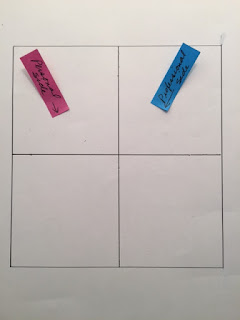
dividing life into personal and professional categories
Personal & Professional
Two of the quadrants are related to my personal life. The other two quadrants are related to my professional life. I titled my four square quadrants:
  1. Personal: activities that focus on me alone, such as my health, fitness, and personal development goals
  2. Home/Others: activities that focus on my personal life and involve others, such as family relationships and my home environment
  3. Creative: activities that focus on me alone and are related to my professional side
  4. Work/Others: activities that focus on my professional life and involve others, such as my employment with the university and the symphony and my private teaching studio
I further divided each of the four quadrants with 8 dissecting lines that vary horizontally and vertically for visual appeal. These 8 segments will represent 8 goals that I intend to accomplish in the next 90 days.

4 Quadrants with 8 Goal Lines
I also made up a blank template of these items and categories for ease of planning in the future.


I set to work on my template and made a list of 8 results or outcomes that I want to achieve in the next 90 days in each of the four areas represented by a square quadrant. I limited myself to 8 items in each of the four quadrants in order to keep my life balanced. I will admit that I found it difficult to come up with 8 items in some areas and to limit myself to 8 in other areas. Such is the difficulty of balancing life priorities.

I added three columns on the right side of my lists and labeled the columns: 30 -- 60 -- 90. I went through my lists of outcomes and results and determined which items would be completed in 30, 60, or 90 days. To my surprise, the tallies appeared to be balanced as well.


As I set about my next 90 days, I will color in the square segments as I complete items for a visually appealing representation of the work that I accomplish. There will be a few instances when an item on a list has some subtasks or subparts to complete. I will most likely partially fill in segments of the square to represent these subparts. The coloring process does not need to be exact or perfect. The color square is to be a helpful tool, not another life burden.

What's on the back side? A few items in my list needed further breakdowns or notes, and I used the reverse side to do this planning:


At the end of my 90 day period, I have set aside the subsequent month as a time to consider and plan for my next 90 day push. That means that I have basically divided my year into three larger segments of 120 days, and this breakdown seems to follow my usual routine of the year:
  • January-April: This period follows the general university semester calendar.
  • May-August: This time period finishes the school year and covers the summer break.
  • September-December: This time period includes the fall school semester.
As you can see from this breakdown of the year into 120-day segments, the three segments seem to coincide with natural break points in the year. For the first 90 days of each 120-day segment, I plan to achieve the goals that I have set to accomplish in those three months. The fourth month will be a time to celebrate what I achieved, evaluate how well the process worked, and consider what new outcomes or results I want to achieve in the next 90 days.

I have designed my template to fit my bullet journal. I will provide more information about the bullet journal in a future article. I used my bullet journal to help me make my goal lists and plans for the 90-day square.

I hope that you will join me in this 90-day twist to goal setting. If you are interested in trying the 90 day square idea, you can find the template here.

Happy Practicing!

----- Paula -----

© 2017 by Paula E. Bird

The above book links are affiliate links (Amazon), which means that I may receive a small benefit at no additional cost to you. As always, you never need to purchase anything, but if you are in the market to do so, consider using the provided affiliate links in order to support the time and efforts of writing and producing the Teach Suzuki blog and podcast.

Wednesday, December 21, 2016

Best Year Yet

Are you disappointed with last year's results? I look forward to inviting my annual guest to visit at this time of year. I do a Best Year Yet analysis in the month of December as I anticipate the start of another year. The results always surprise me.

The Best Year Yet analysis comes from a book I read back in 1994 by Jinny S. Ditzler:


This book sets out 10 important questions, and the answers will help to shape and guide you as you plan for your next fabulous year of accomplishments. As you consider and answer the ten questions, you will celebrate your accomplishments, consider your disappointments, identify honestly the way in which you limit yourself, explore your personal values, determine which roles you wish to include in your life, and create a new empowering paradigm to achieve your goals for the year for each of the roles.

This is a very thorough process and is not an activity that I do quickly. I begin in early December by pulling the book off my shelf and skimming the parts of the book that I have outlined over the years. Sometimes I read parts of the book again, because I find that each year I discover new things within the book that appeal to me in different ways. This year is no different.

If you turn to the goal setting process at this time of year, as many of us do, and you seek a different perspective from the goal-setting hype and noise that shows up daily in our email inboxes, consider exploring Jinny Ditzler's 10 Questions. I am certain that you will discover some very surprising things about yourself in the process.

I have written about this subject in previous years. If you would like to review those articles for more inspiration, here are some links to help you get started:

Your Best Year Yet!: This is an updated article about the BYY program and the 10 questions.

Just Desserts!: This updated article focuses on the first question, which looks at what we accomplished during the year. This is a step that many people ignore or forget, and yet the answer to this question may provide the necessary power to fuel goals for the next year.

Disappointments and Life Lessons: This updated article focuses on questions 2 (disappointments) and 3 (what did I learn).

Limits and Complaints: This updated article focuses on question 4 and any beliefs that may be limiting goals progress.

Happy Practicing!

----- Paula -----

© 2016 by Paula E. Bird

The above book link is an affiliate link (Amazon), which means that I may receive a small benefit at no additional cost to you. As always, you never need purchase anything, but if you are in the market to do so, consider using the provided affiliate links in order to support the time and efforts of writing and producing the Teach Suzuki blog and podcast.